OKX review: is the pro toolkit and built-in Web3 wallet worth it over Binance?
We traded spot on OKX's terminal, ran assets through the built-in Web3 wallet, and checked its fee tiers and February 2025 guilty plea against what Binance offers an active trader.
7.8out of 107.8
Our verdict
OKX earns its reputation as the exchange for a trader who wants a real order book and a real wallet in one login: spot fees undercut Binance's standard tier, the terminal has depth Binance's simplified app does not bother with, and the Web3 wallet covers 130-plus chains without leaving the app. The February 2025 guilty plea and the 504 million dollar settlement over unlicensed money transmission are not ancient history, and OKX now operates under an external compliance consultant through February 2027, a detail a cautious trader should weigh before moving size onto the platform.
Best for: Active traders who want a deep order book and an integrated Web3 wallet in one app
OKX pitches itself as faster, better and stronger than the average crypto exchange, and for once the tagline is a real question rather than filler. We opened an account, funded it, traded on the spot terminal, and moved a slice of that balance into the built-in Web3 wallet to see whether the pro toolkit actually beats Binance for someone who trades often.
The fee gap over Binance is real, but only globally
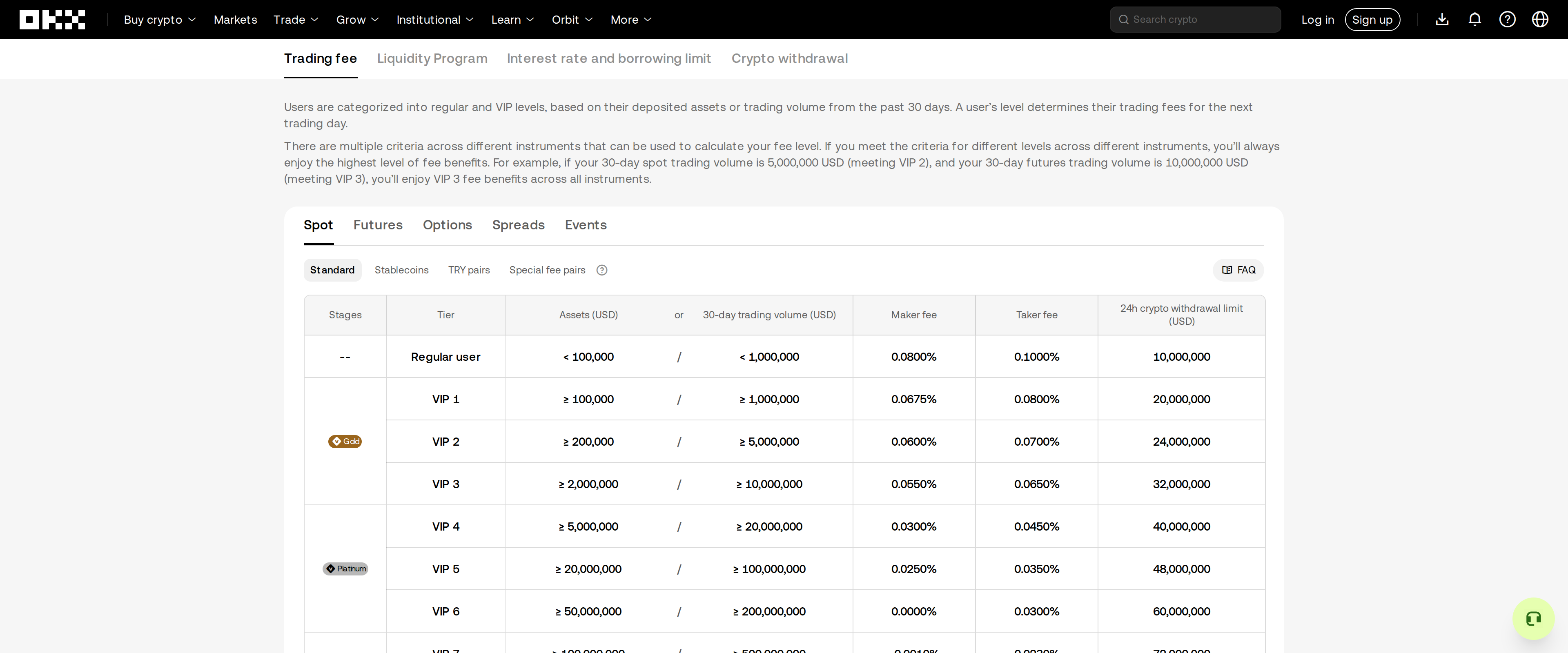
OKX's global spot ladder opens at 0.08 percent maker and 0.10 percent taker, a shade below Binance's standard 0.10/0.10 tier. That is not a rounding error for anyone trading daily; on a 50,000 dollar monthly turnover it is the difference of a few dollars a week, and it compounds.
OKX's fee tier page: regular and VIP levels are set by deposited assets or recent trading volume
The US account runs on a separate, worse ladder: 0.20 percent maker and 0.35 percent taker at entry, with the two fee systems unable to combine. A US-based trader who assumes the global headline rate applies to them will be paying roughly double what the marketing implies, and only heavy volume closes that gap; an August 2026 snapshot of the US VIP 9 tier showed fees as low as negative 0.005 percent maker, a level almost nobody reaches.
A terminal built for someone who already knows what an order book is
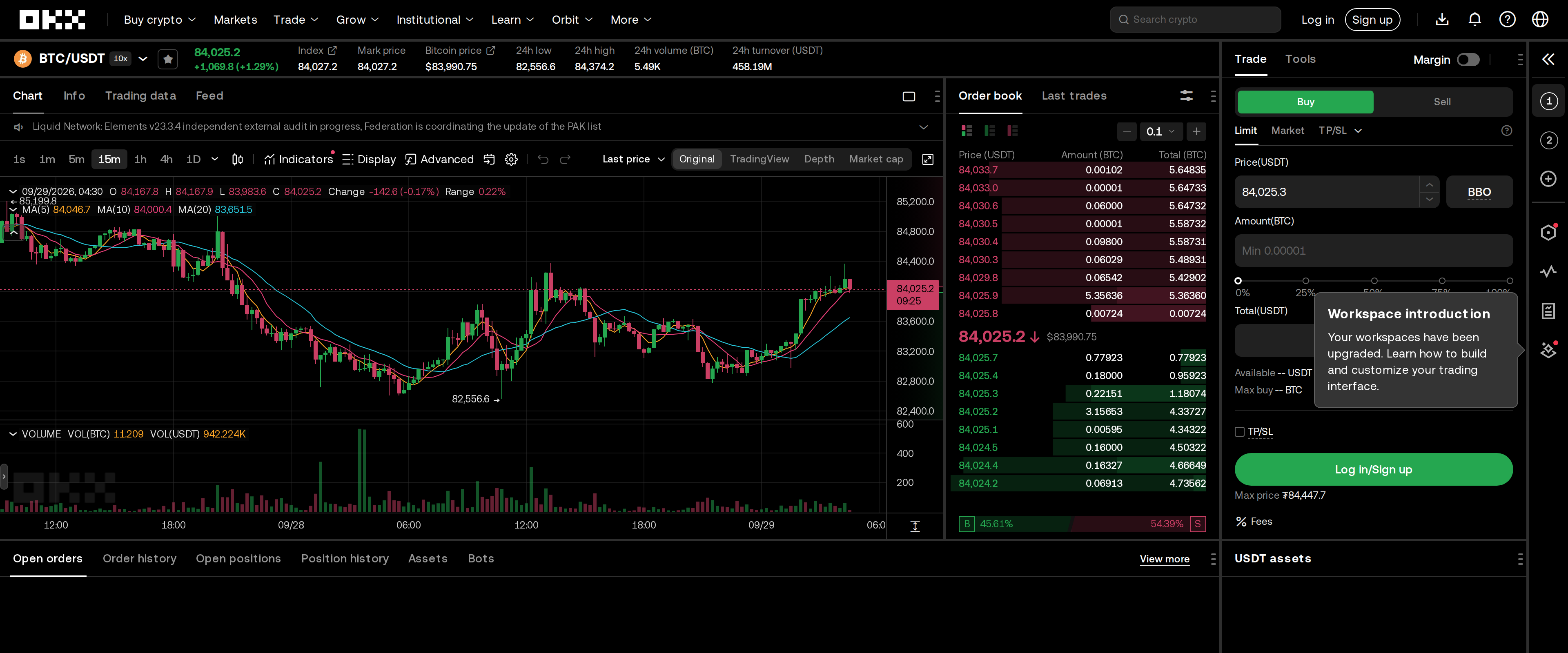
Binance's app increasingly nudges casual users toward a simplified buy-and-hold flow. OKX has not made that trade-off. The spot terminal we traded on keeps full order book depth, multiple chart timeframes and a limit-order panel front and center, with no simplified view hiding behind it.
OKX's BTC/USDT spot terminal: full order book, MA(5)/MA(10)/MA(20) overlays and volume panel
Grid bots and copy trading sit inside the same terminal rather than through a bolted-on partner integration, which matters if you have ever tried to reconcile a third-party bot's fills against an exchange's own trade history. Availability of both still depends on your region and account entity, so confirm access before building a strategy around either one.
The Web3 wallet is the real differentiator, and the real extra risk
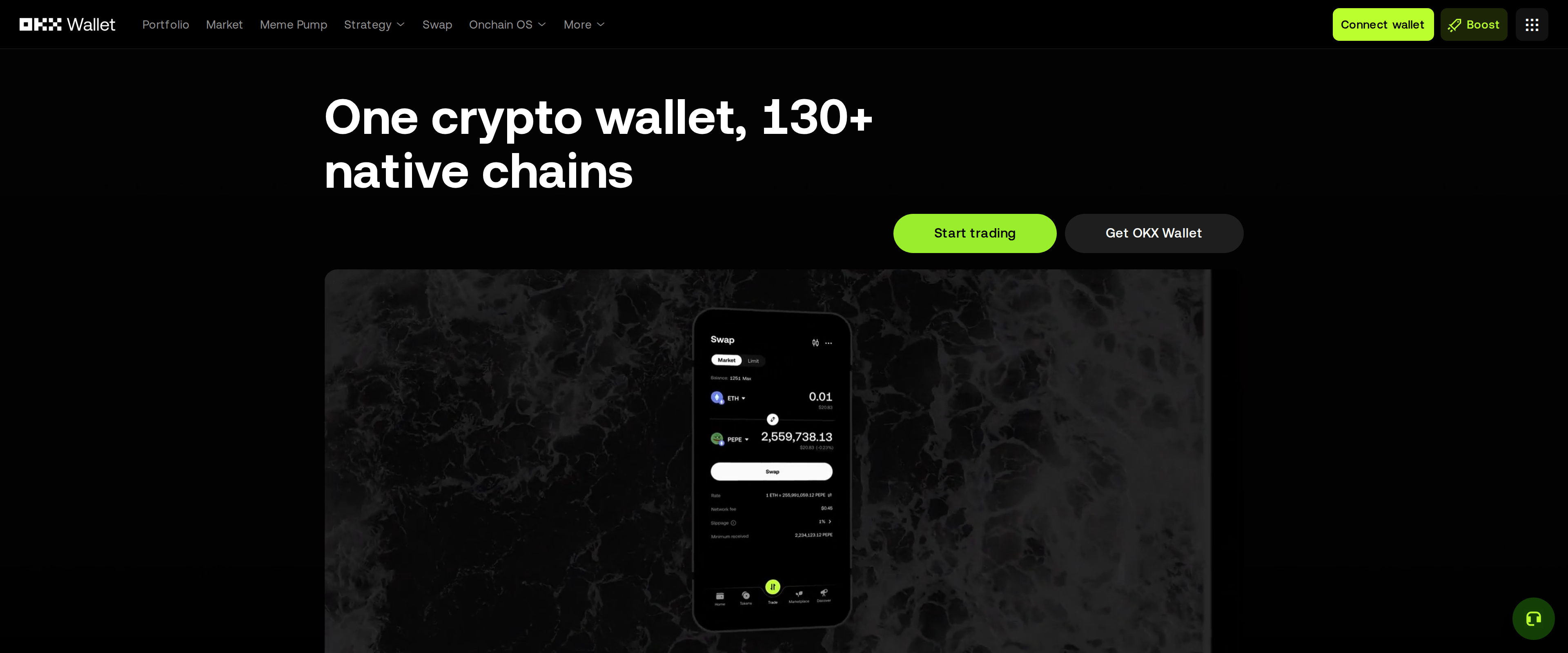
This is where OKX separates itself from Binance most clearly. The OKX Web3 wallet lives in the same app as the exchange and covers more than 130 native chains, from the major EVM networks to Solana and Bitcoin, without a separate download or account.
OKX Wallet's pitch: one non-custodial wallet across 130+ chains, with portfolio and strategy tools built in
That convenience carries a cost the marketing does not lead with. The wallet is non-custodial, so keys sit with the user, and the client is closed source, so its security claims cannot be independently audited line by line the way an open-source wallet's can. Its DEX aggregator selects a swap route, but the user signs the transaction and carries the on-chain execution risk if a bridge or protocol underneath that route fails. A CertiK and SlowMist audit, most recently in April 2026, found no key or mnemonic leakage, and a bug bounty runs on HackenProof, which is a reasonable floor of assurance without being a guarantee.
The compliance history is not optional reading
In February 2025, OKX's operating entity pleaded guilty to running an unlicensed money transmitting business and violating anti-money laundering law in the United States. The penalty totaled 504.7 million dollars: an 84.4 million dollar fine plus 420.3 million dollars in forfeiture, tied to prosecutors' claim that the platform processed more than 5 billion dollars in suspicious transactions. As part of that settlement, OKX now operates under an external compliance consultant through February 2027.
None of that points to a loss of customer funds; the guilty plea concerns compliance controls, not theft, and the exchange's 44th Proof of Reserves report in July 2026 verified 22.65 billion dollars in primary assets using wallet ownership checks and zk-STARK-based balance proofs. We would still tell a reader to treat the settlement as a live compliance record, not a closed chapter, given the consultant mandate runs into 2027.
Who should actually open an account
A trader who already runs size through a terminal, wants the fee edge over Binance's standard tier, and would use a single app for both exchange trading and on-chain activity gets real value from OKX. The order book depth and the Web3 wallet integration are not marketing flourishes; we used both in the same session without switching apps, which Binance still cannot offer at the same level of polish.
A US-based trader chasing the lowest possible fee should read the separate US ladder carefully before assuming the global rate applies, and anyone weighing custody risk against convenience should treat the 2025 settlement and the wallet's closed-source client as real factors, not footnotes. We would open the account for the terminal and the wallet together, and keep an eye on how the compliance consultant's oversight plays out before moving a large balance onto the platform.
What we liked
Spot fees start at 0.08% maker / 0.10% taker globally, undercutting Binance's 0.10%/0.10% standard tier
Web3 wallet covers 130+ chains natively, with DEX aggregation, in the same app as the exchange
44th Proof of Reserves report (July 2026) verified 22.65 billion dollars in primary assets via zk-STARK checks
Grid bots and copy trading are built into the terminal, not bolted on through a third-party integration
What held it back
Pleaded guilty in February 2025 to operating an unlicensed money transmitting business, with 504 million dollars in fines and forfeiture
Runs under an external compliance consultant through February 2027 as part of that settlement
US account fee ladder (0.20% maker / 0.35% taker at entry) is separate from and worse than the global ladder
Web3 wallet is non-custodial and closed source, so DEX routing risk and key security both sit with the user
Specs
Global spot fee, entry tier
0.08% maker / 0.10% taker
US spot fee, entry tier
0.20% maker / 0.35% taker
US VIP 9 fee (Aug 2026 snapshot)
-0.005% maker / 0.015% taker
2025 settlement
84.4M USD fine plus 420.3M USD forfeiture, 504.7M USD total
Compliance monitoring
External consultant mandated through February 2027
Web3 wallet chains
130+ native chains, non-custodial
Proof of Reserves, Jul 2026
22.65B USD in primary assets (44th report)
US licensing
FinCEN-registered, money-transmitter licenses in 40+ states