Bybit review: is it safe after the 2025 hack, and worth the risk?
We traded spot and perpetuals on Bybit, checked how the exchange covered a $1.46 billion hack in February 2025, and weighed its recovery record against its fees before scoring it for an active trader.
6.9out of 106.9
Our verdict
Bybit's response to the February 2025 hack was fast and largely transparent: leadership recapitalized the reserve from its own balance sheet, loans and counterparties within roughly 72 hours, and kept processing withdrawals throughout, with 99.994% of 350,000 requests cleared inside 10 hours. That response does not undo the fact that attackers took 1.46 billion dollars through a compromised signing process, and a trader weighing Bybit against Kraken or Coinbase should treat the hack as a real mark against its security posture, not a settled matter, even with reserves now reported above 100%.
Best for: Active derivatives traders who accept the 2025 hack risk in exchange for deep tools
Bybit's history now splits cleanly into before and after February 21, 2025. We traded spot and perpetual futures on the exchange, dug into how the exchange handled the hack that day, and weighed the fee structure and recovery record against what a trader gives up by choosing Kraken or Coinbase instead.
What actually happened on February 21, 2025
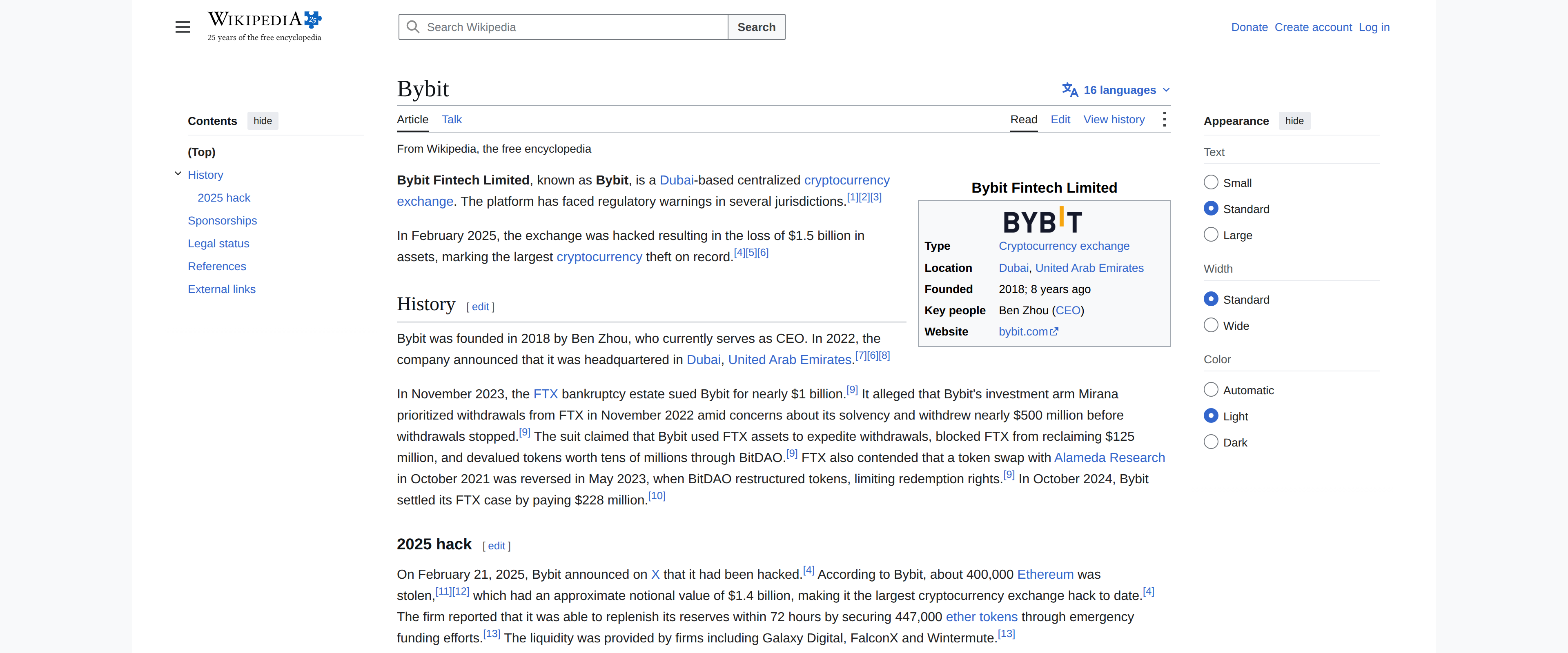
Attackers stole approximately 1.46 billion dollars during a routine cold-to-warm wallet transfer: roughly 401,347 ETH plus staked derivatives including stETH, cmETH and mETH. The method was not a brute-force break-in; it exploited compromised Safe-related infrastructure and malicious JavaScript that manipulated what Bybit's signers saw on screen during approval. US authorities later attributed the attack to North Korea's Lazarus Group, tracked under the TraderTraitor designation, the same actors behind several of the largest crypto thefts on record.
The recovery was fast, and that matters, but it is not the whole story
Bybit did not pause withdrawals to sort out the damage. Leadership sourced ETH from the company's own balance sheet, short-term loans and external counterparties, restoring full reserve coverage within roughly 72 hours of the theft. Through the crisis the exchange processed about 350,000 withdrawal requests, with 99.994 percent clearing inside 10 hours, a detail that separates this response from exchanges that have frozen withdrawals during past incidents and left users waiting weeks for an update.
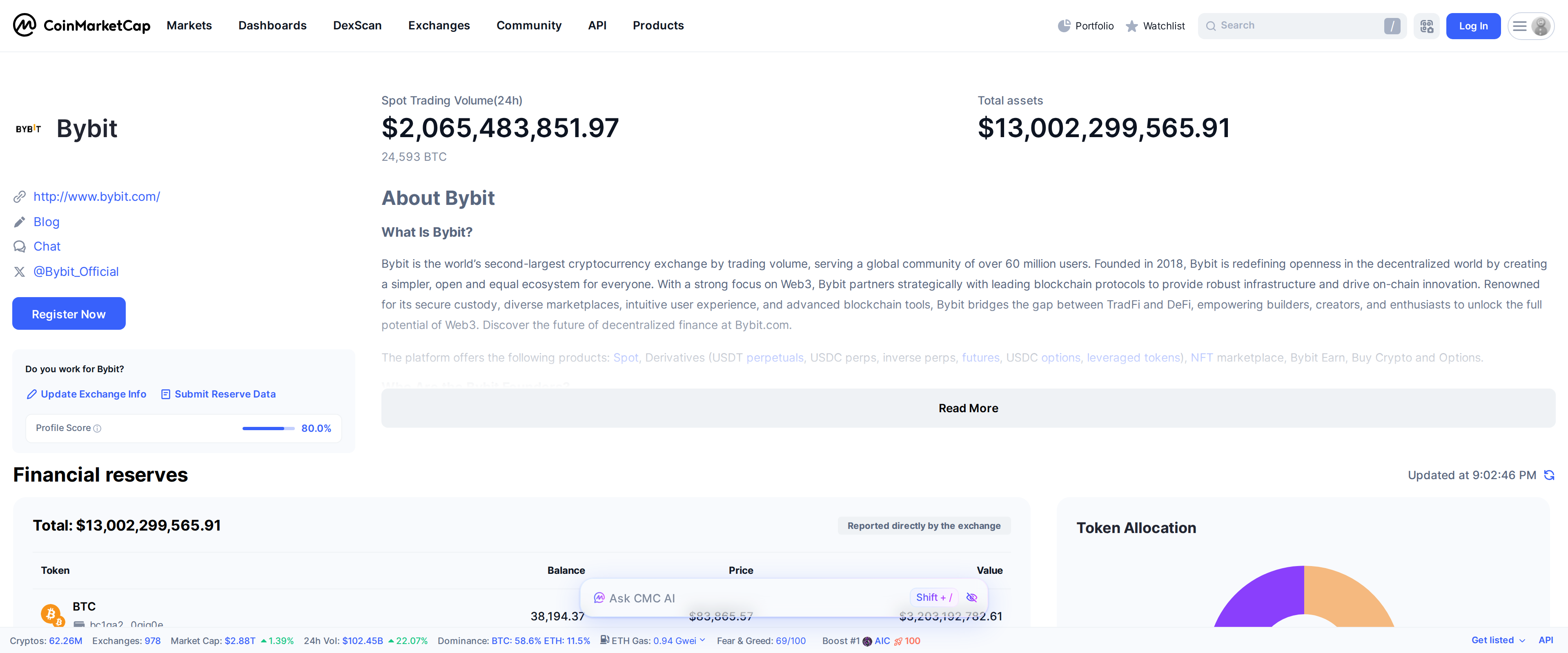
Bybit's CoinMarketCap listing: reported reserves and 24-hour spot volume, with a token allocation chart alongside a financial reserves table
As of the most recent disclosure, Bybit's Proof of Reserves shows coverage above 100 percent, verified through Hacken assessment, Merkle-tree checks and disclosed wallet ownership. We would still flag the standard caveat that comes with any proof of reserves: it can confirm assets exist at a point in time, but it cannot rule out undisclosed liabilities and it does not guarantee solvency going forward. Treat the number as reassuring, not conclusive.
Trading the platform itself
Set the hack aside for a moment and Bybit is a genuinely deep terminal for an active trader. Spot fees start at 0.10 percent maker and taker, matching the industry standard rather than undercutting it, but perpetual futures open at 0.02 percent maker and 0.055 percent taker, competitive territory for anyone running size through derivatives. Push into the VIP Supreme tier and spot fees fall to 0.03 percent maker, 0.045 percent taker, with perpetuals maker fees approaching zero.
Bybit's Google Play listing: the Android client entry alongside its about and support sections
Copy trading is widely regarded as the strongest in the industry, and the Unified Trading Account lets spot, derivatives and options positions share a single margin pool instead of forcing transfers between separate wallets before every trade. The trade-off is a platform dense enough that a first-time crypto user will find it more intimidating than Coinbase's simplified app, and it is not a place to learn the basics.
Order execution felt fast in both markets we tested, with no visible lag between placing a limit order and seeing it fill on the book. Spot coin selection trails Binance, and fiat on-ramp options are thinner in several regions, so a trader who wants to buy dozens of small-cap tokens directly with a bank transfer may still need a second exchange alongside Bybit.
Where you can and cannot use it
Bybit remains unavailable to US users, with no announced date to return, a restriction that has held since May 2023. The UK reopened access in December 2025, though with a narrower set of spot and P2P products than the full platform offers elsewhere. In Europe, Bybit EU GmbH received MiCAR authorization from Austria's Financial Market Authority on May 28, 2025, covering custody and crypto-trading services under the bloc's newer regulatory framework, a real step up from operating on offshore licensing alone.
Bybit's Wikipedia entry: the 2025 hack listed as its own subsection under the exchange's history
Who should open an account, and who should wait
A trader who wants derivatives depth, values the Unified Trading Account, and has read the hack timeline closely enough to trust the recovery process gets real functionality here that Coinbase does not offer. The fee structure rewards volume aggressively, and copy trading is a genuine differentiator for someone who wants exposure without running their own strategy.
Anyone whose top priority is a clean multi-year security record, ahead of raw trading tools, should look at Kraken first; fourteen years without a platform-level breach is a different kind of track record than a fast recovery from one. We would open a Bybit account for the derivatives toolkit specifically, keep only trading capital on the platform, and treat February 2025 as a live data point about the exchange's risk profile rather than a closed incident.
What we liked
Restored full reserve coverage within roughly 72 hours of the $1.46 billion February 2025 hack
Kept withdrawals open through the crisis, clearing 99.994% of 350,000 requests within 10 hours
Perpetual futures fees from 0.02% maker, dropping toward 0% maker at VIP Supreme tier
Bybit EU GmbH received MiCAR authorization from Austria's FMA on May 28, 2025
What held it back
Lost $1.46 billion in ETH and staked ETH derivatives on February 21, 2025 to North Korea's Lazarus Group
Attack exploited compromised Safe-related infrastructure and malicious JavaScript targeting the signing process
Remains unavailable to US users, with no announced timeline to return
Proof of Reserves cannot reveal undisclosed liabilities or guarantee future solvency, by the audit's own disclosure
Specs
Spot fee, entry tier
0.10% maker / 0.10% taker
Perpetuals fee, entry tier
0.02% maker / 0.055% taker
VIP Supreme spot fee
0.03% maker / 0.045% taker
Feb 2025 hack loss
$1.46B in ETH, stETH, cmETH and mETH
Reserve restored
Within ~72 hours, from balance sheet, loans, counterparties
Withdrawals during crisis
~350,000 requests, 99.994% cleared within 10 hours
EU license
MiCAR authorization, Bybit EU GmbH, granted May 28, 2025