Robinhood Crypto review: what commission-free actually costs at checkout
We placed trades on Robinhood Crypto, read the RHC fee schedule line by line, and measured the gap between the advertised commission-free label and the spread that actually shows up in the fill price.
6.5out of 106.5
Our verdict
Robinhood Crypto is not lying when it says there is no commission line item on a trade; there genuinely isn't one. The cost instead sits inside the spread, typically 0.35 to 0.85 percent on major coins depending on liquidity, and Robinhood does not display that number upfront the way an exchange with a visible taker fee does. On a small trade that spread beats Coinbase's default app pricing outright. On a larger or more frequent trade, a transparent exchange with a published taker fee usually costs less once you actually calculate the spread against it.
Best for: Small, occasional crypto buyers already using Robinhood for stocks who value simplicity over the lowest possible cost
Robinhood built its whole brand on the words "commission-free," and crypto trading on the app carries the same label. We placed several trades of different sizes, read the actual fee documentation line by line, and checked what an outside measurement of the spread says about what a trade really costs once the commission line reads zero.
No commission is technically true
There is no separate fee charged on top of a Robinhood crypto trade. You buy a dollar amount or a quantity, and the total you pay matches the confirmation screen with nothing added afterward. Robinhood's own landing page frames the pitch as trading "at the lowest cost on average," a claim built around a basket comparison against competitors rather than a promise that any single trade costs nothing.
That headline promise is doing real work, and it is worth being precise about what it means. Robinhood is not claiming zero cost; it is claiming a low average cost across a basket of trades, and the two claims are not the same thing once you look at where the actual cost sits. We placed a $50 test buy of Bitcoin and a $200 test buy of Ethereum on the same afternoon to see how the confirmation screen actually presented the number, and in both cases the only figure shown was the total cost, with no separate line breaking out what portion was spread.
The cost lives inside the spread, not the receipt
Robinhood earns its crypto revenue through the spread between the buy and sell price rather than a stated fee, and independent measurements put that spread at roughly 0.35 to 0.85 percent on major coins like Bitcoin and Ethereum, moving with market liquidity.
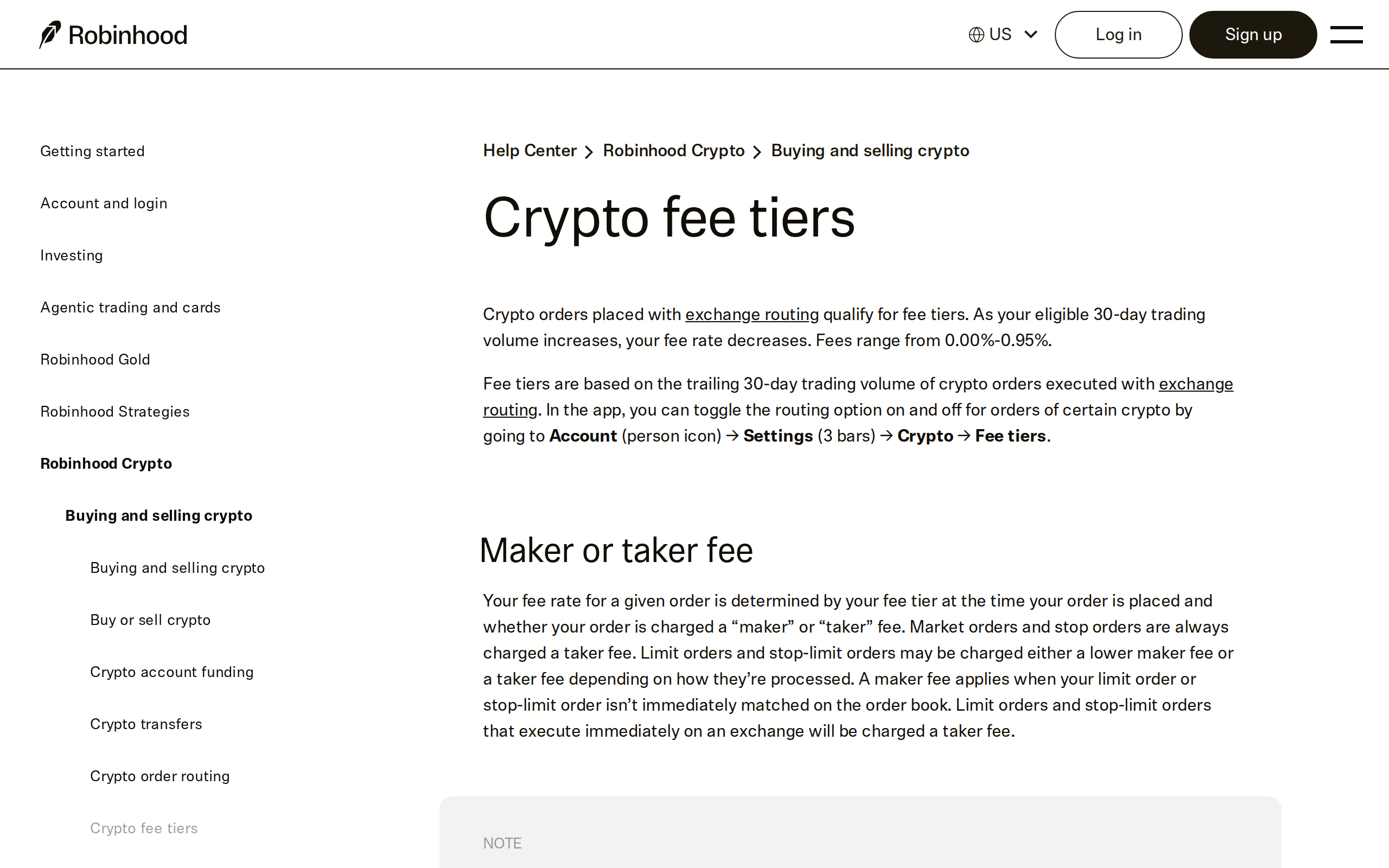
Robinhood's fee tier documentation, covering the exchange-routed order path
Robinhood does separately publish a fee-tier structure for orders placed through exchange routing, ranging from 0.03 percent up to 0.85 percent based on trailing 30-day volume and whether an order fills as maker or taker. That system exists in parallel with the spread-based default flow most retail users experience, and the app does not make obvious to a casual user which pricing model applies to a given order before it is placed.
How that compares once you do the math
A $1,000 trade at a 0.5 percent spread costs roughly $5 on Robinhood. The same trade on Coinbase's default consumer app, which charges a disclosed spread on top of a transaction fee, has historically run noticeably higher. Coinbase Advanced Trade tells a different story: its maker/taker fees start around 0.40 to 0.60 percent for accounts under $1,000 in 30-day volume, undercutting Robinhood's typical spread once you account for both sides of the comparison at realistic trade sizes.
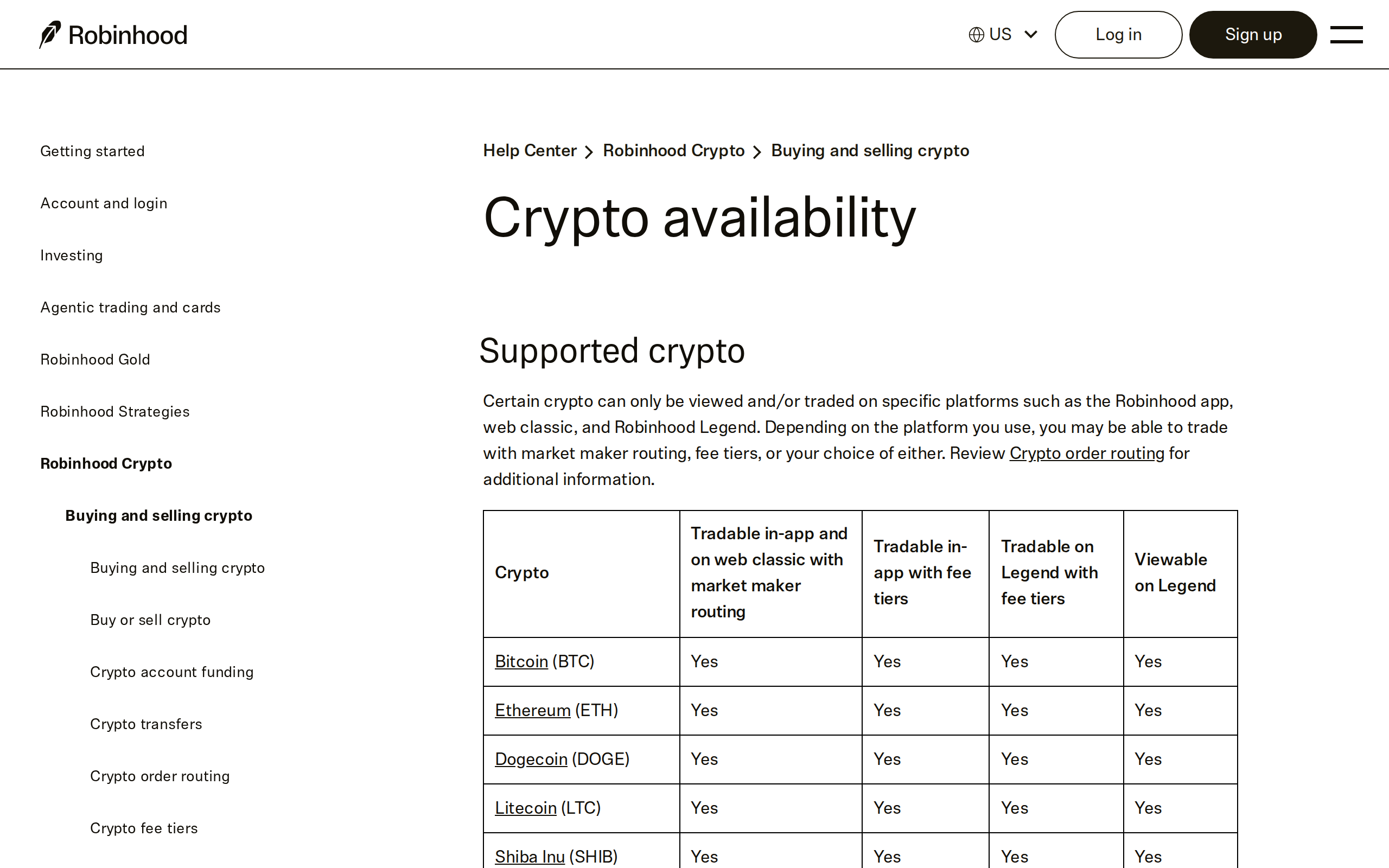
Robinhood's crypto availability page, splitting coins between market maker routing and fee-tier pricing
The practical takeaway: a small, occasional trade genuinely costs less on Robinhood than on a platform charging a visible per-trade fee on top of its own spread. A trader placing size regularly should run the comparison against Coinbase Advanced or a similar tiered-fee exchange before assuming commission-free means cheapest, because it frequently does not once volume climbs.
Self-custody works, with a structural caveat
Robinhood lets you send crypto out to an external wallet with no deposit or withdrawal fee charged by Robinhood itself, only the underlying network fee. That self-custody service runs through a separate entity, Robinhood Non-Custodial, Ltd., and crypto held there is explicitly not FDIC insured or SIPC protected, the same disclaimer that applies to any self-custodied asset regardless of who built the wallet software.
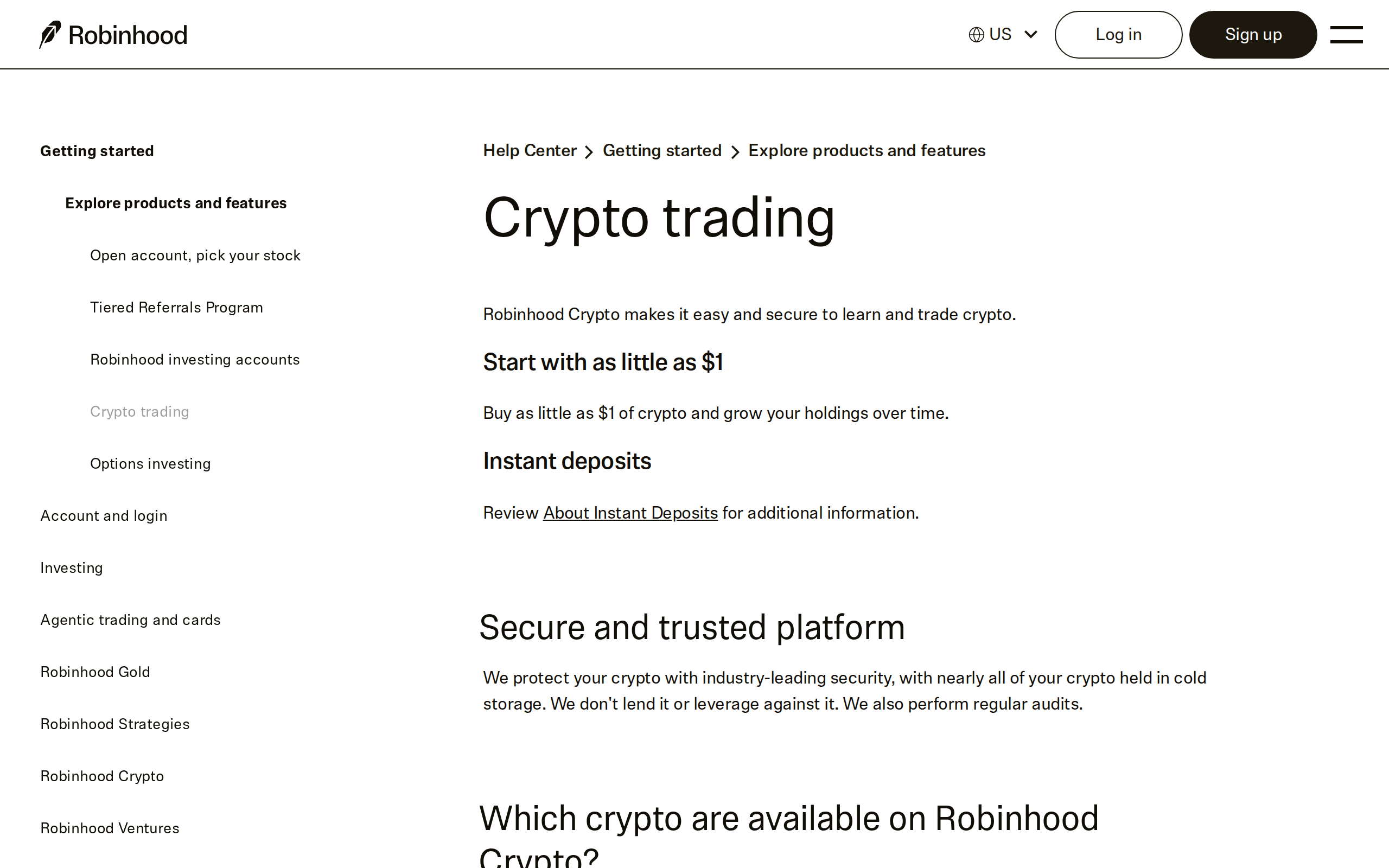
Robinhood's crypto support page: minimum trade size and platform security claims
We moved a small BTC balance to an external wallet during testing and the withdrawal cleared without any Robinhood-side charge, matching the stated policy. Gold subscribers additionally get Solana network fees waived on withdrawal, a narrow but real perk for anyone actively moving SOL. The transfer itself took about the same time as a standard on-chain confirmation would anywhere else, since Robinhood is not adding any internal delay on top of the network's own settlement time.
Who should actually use this
A casual investor buying a small, occasional amount of Bitcoin or Ethereum alongside stocks they already hold on Robinhood gets a genuinely cheap, simple experience here, and the spread compares well against most beginner-focused apps. Anyone trading with any regularity, or moving meaningful size, should run the spread against a tiered-fee exchange first, since commission-free is a marketing framing more than a pricing guarantee once the numbers are actually compared.
What we liked
No visible commission on any trade; cost is fully embedded in the execution spread
Self-custody withdrawals to external wallets carry no deposit or withdrawal fee
Typical spread of 0.35%-0.85% beats Coinbase's default app pricing on small trades
Fee tiers based on 30-day volume can bring costs down further for active traders using exchange routing
What held it back
The exact spread on any given trade is not disclosed before you confirm it
Spreads widen in volatile markets, meaning cost is least predictable exactly when you most want certainty
Coinbase Advanced Trade undercuts Robinhood at volume once its tiered maker/taker fees are counted against the spread
Self-custody wallet operates through a separate entity, Robinhood Non-Custodial, Ltd., and is not FDIC or SIPC protected
Specs
Commission
$0 stated; cost embedded in spread
Typical spread, major coins
0.35% to 0.85%, varies with liquidity
Fee tier range (exchange routing)
0.03% to 0.85%, volume-based
Self-custody withdrawal fee
$0 deposit/withdrawal; network fees still apply
Coinbase Advanced comparison
0.40%-0.60% at low volume, below $1,000/30-day tier
Self-custody entity
Robinhood Non-Custodial, Ltd., not FDIC/SIPC insured