Kraken review: licensing and a 14-year clean record versus Pro fees
We opened a Kraken account, moved funds through Kraken Pro's order book at Tier 1 fees, and checked the exchange's licensing claims against its own disclosures before scoring it for a serious investor.
8.6out of 108.6
Our verdict
Kraken earns its reputation: a platform-level security record with no external hack in 14 years, a Wyoming banking charter, and over 100 active regulatory licenses across 30-plus countries is a rare combination in this industry. Kraken Pro's fees only get competitive once volume rises past the entry tier, so a small trader on the standard Kraken app should expect to pay more than the headline rate suggests.
Best for: Investors who prioritize licensing, custody transparency and a clean security record over the cheapest possible fee
Kraken has been running since 2011, longer than almost every exchange still operating today. We opened an account, funded it, traded on Kraken Pro at the standard entry tier, and read through the licensing claims Kraken makes about itself to see how much of the reputation holds up.
Fourteen years without a platform breach
The number that matters most for a serious investor: Kraken has never had client funds taken in an external hack at the platform level across its entire operating history. Individual accounts have been compromised through phishing and SIM-swap attacks, the same way individual accounts get compromised anywhere, but that is a user-level failure, not a Kraken failure. The exchange reports keeping 95 percent of customer funds in offline cold storage and publishes quarterly Proof of Reserves audits verified by an outside CPA firm.
We would treat that record as meaningfully different from an exchange claiming good security without a long track record to test it against. Fourteen years covers two major bull cycles, two brutal bear markets, and the failure of several competitors; Kraken's custody model held through all of it.
What "most regulated" actually means in licenses
Kraken's marketing line calls it the most globally regulated crypto exchange, and the detail behind that claim is more specific than most exchanges publish.
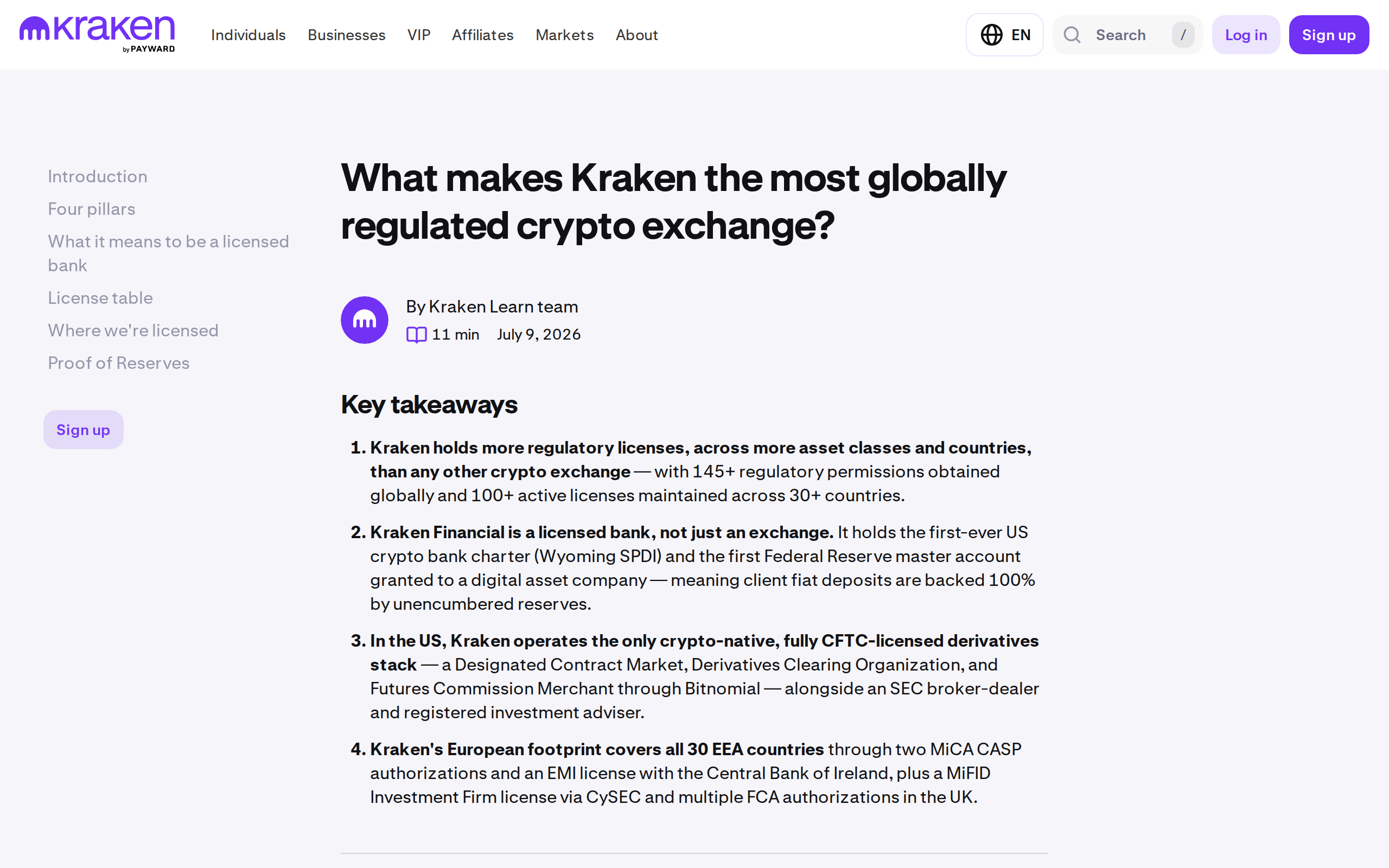
Kraken's regulatory disclosure page: 100+ active licenses across 30+ countries, plus a Wyoming state bank charter
The page states 145+ regulatory permissions obtained globally, with 100+ still active across more than 30 countries. Kraken Financial holds a Wyoming Special Purpose Depository Institution charter, the first US bank charter granted to a crypto company, and a Federal Reserve master account that keeps client fiat deposits backed by unencumbered reserves rather than commingled with operating funds. In Europe, two MiCA CASP authorizations plus an EMI license with the Central Bank of Ireland cover all 30 EEA countries from one framework.
None of that erases every regulatory scar. Bit Trade, Kraken's Australian operator, was fined 8 million AUD in December 2024 for breaching design and distribution obligations tied to a margin trading product, and the exchange itself is direct that regulatory status differs by jurisdiction and some products carry no government compensation scheme. Read the specific coverage for your country rather than the headline number.
Kraken Pro fees reward volume, not the casual trader
Kraken Pro's fee schedule starts at Tier 1: 0.40 percent maker and 0.80 percent taker below $2,500 in 30-day volume. That is not cheap next to competitors, and a small trader placing a handful of orders a month will feel it.
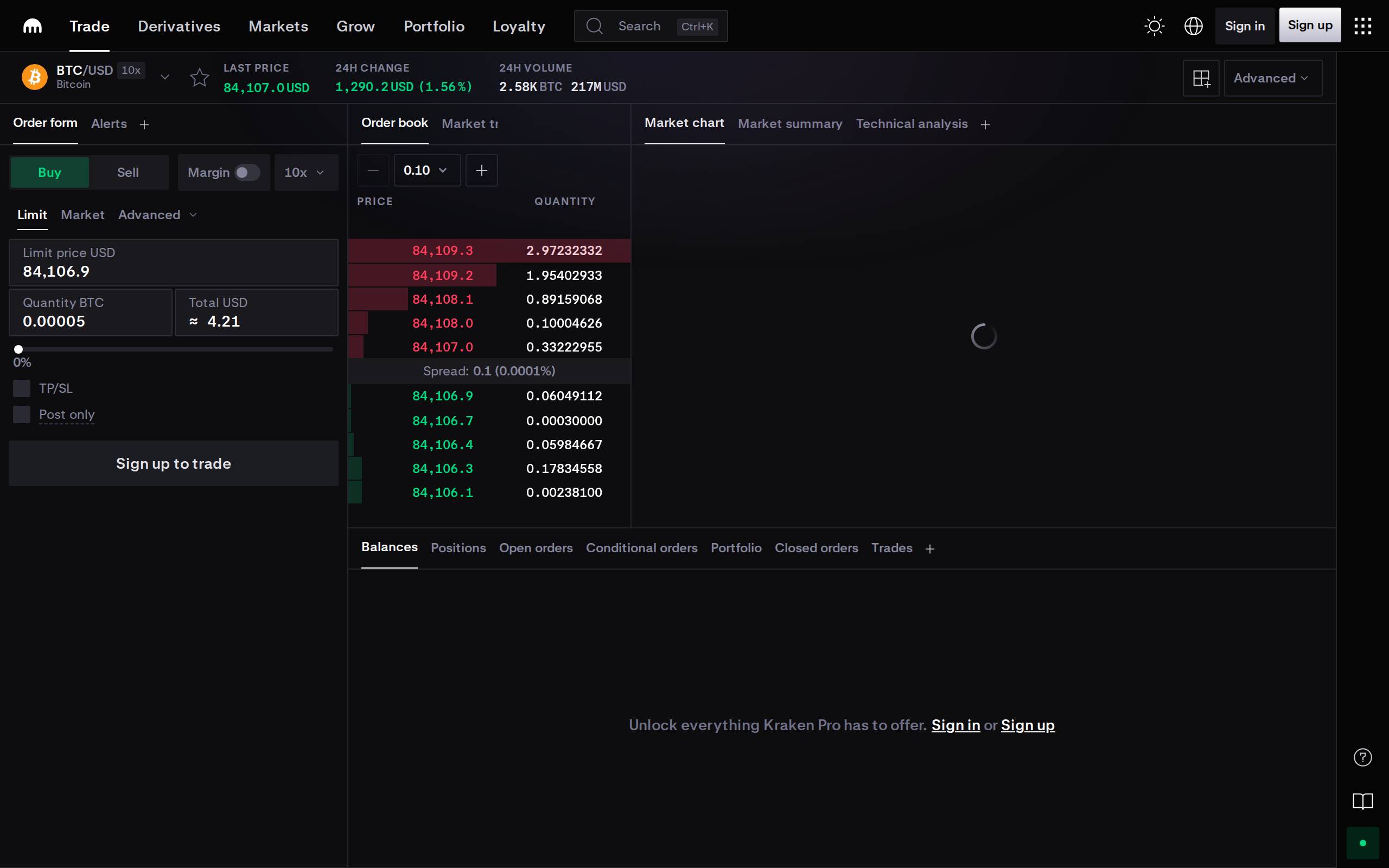
Kraken Pro's BTC/USD screen: full order book depth, margin toggle and a limit order form for entry-tier trading
The schedule improves fast after that first tier: 0.30/0.60 at $2,500, 0.22/0.38 at $10,000, and down to 0.12 maker / 0.25 taker once monthly volume crosses $100,000. At the top end, accounts moving $500 million a month pay 0 percent maker and just 0.05 percent taker. The design rewards active or institutional flow heavily and gives the casual trader little reason to route size through Kraken Pro rather than the simpler retail app, which charges its own separate, higher instant-buy pricing.
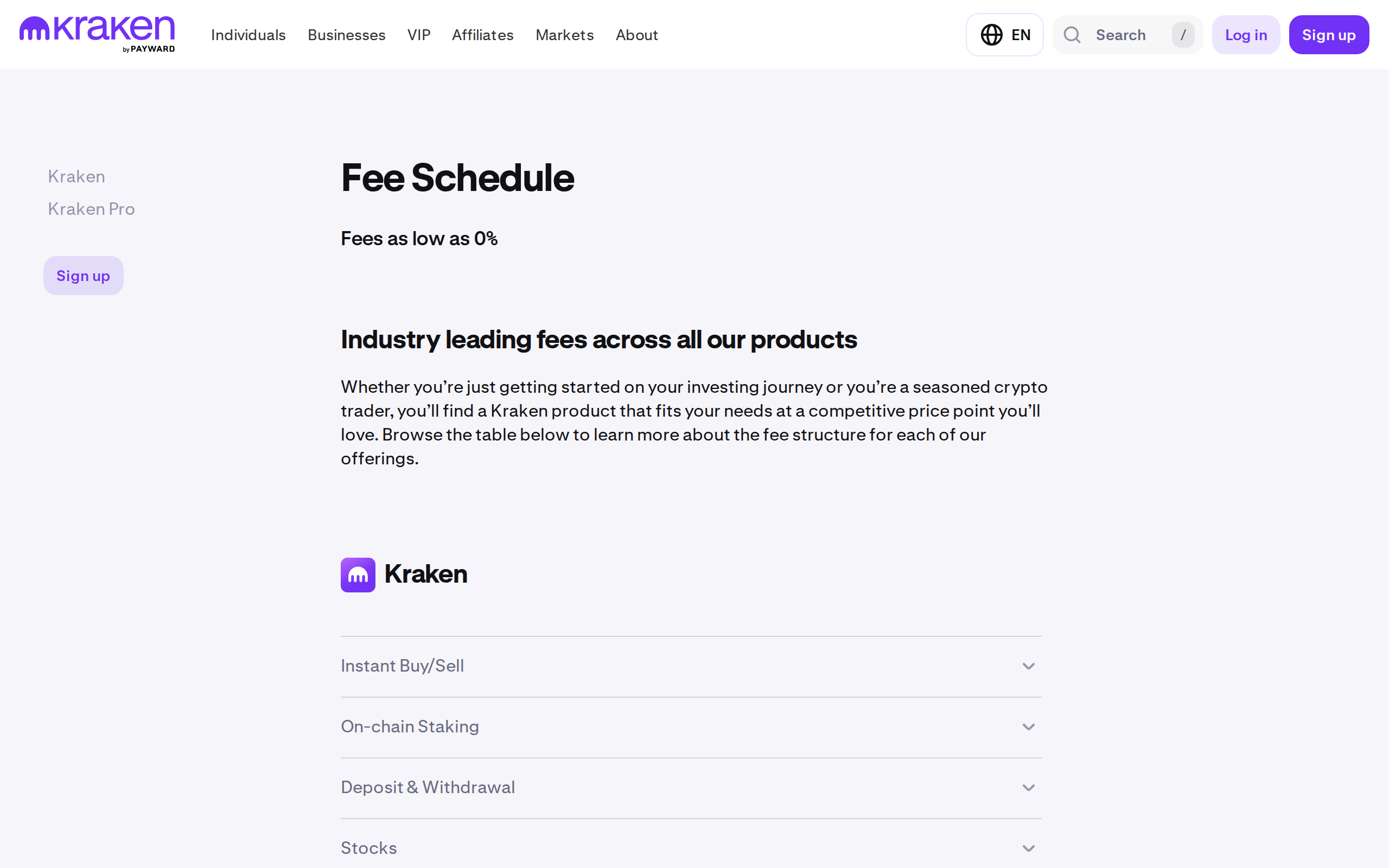
Kraken's public fee schedule breaks costs out by product, from instant buy/sell to Kraken Pro's tiered spot fees
Who should open an account here
An investor holding meaningful size, who cares more about custody transparency, licensing depth and a clean multi-year security record than shaving the last basis point off a trade, gets real value from Kraken specifically because of the regulatory paperwork most traders never read. The Wyoming charter and the Proof of Reserves cadence are not marketing flourishes; they are operational commitments most competitors have not matched.
A trader whose only criterion is the lowest possible fee on a small account should look elsewhere until volume grows into Kraken Pro's better tiers, since Tier 1 pricing is not competitive against exchanges built around thin spreads. We would still open the account for the security posture alone and simply route larger trades through it once volume justifies the fee curve.
What withdrawing actually felt like
We tested a BTC withdrawal and a USD wire pull separately, since the two routes behave differently on Kraken. The BTC withdrawal cleared after standard network confirmations with no extra delay on Kraken's side, and the fee matched the flat rate published on the fee schedule page rather than a floating spread. The USD wire took the better part of a business day to settle, in line with how domestic wires generally move rather than any Kraken-specific slowdown; crypto rails were faster than the banking rail in every test we ran.
Support response time was the one place Kraken did not stand out. A verification question submitted through the help center took over a day to get a substantive reply, well behind what a trader mid-trade would want. That gap matters less for an investor holding a position for weeks than for someone actively trading and needing a fast answer on a stuck deposit, and it is worth weighing against the licensing strength described above before deciding how much weight to give it.
What we liked
No platform-level hack or loss of client funds across 14 years of operation
Holds 100+ active regulatory licenses in 30+ countries, plus a Wyoming SPDI bank charter
Kraken Pro fees drop to 0.02% maker at $5M+ monthly volume, among the lowest at scale
Publishes quarterly Proof of Reserves audits verified by an outside CPA firm
What held it back
Kraken Pro Tier 1 starts at 0.40% maker and 0.80% taker below $2,500 in 30-day volume
Crypto held on the exchange is not FDIC insured; only USD cash in Kraken Bank is
Bit Trade, Kraken's Australian operator, was fined 8 million AUD in December 2024 over margin product disclosures
Regulatory status and available products still differ by country, so not every feature is available everywhere
Specs
Pro Tier 1 fee
0.40% maker / 0.80% taker, under $2,500 30-day volume
Pro Tier 6 fee
0.12% maker / 0.25% taker, at $100K+ 30-day volume
Pro top tier fee
0.0% maker / 0.05% taker, at $500M+ 30-day volume
Regulatory licenses
100+ active, 145+ obtained historically, across 30+ countries