Raydium review: can you trade new Solana tokens without getting rugged?
Raydium is where a huge share of new Solana tokens list first, through a bonding-curve launchpad called LaunchLab. We checked swap fees, watched fresh LaunchLab listings, and weighed independent rug-pull research against the platform's audit history.
7.0out of 107.0
Our verdict
Raydium's core swap engine is solid: contracts have run since 2021, fees as low as 0.01 percent undercut most rivals, and the AMM v4 pools untouched by 2026's exploit still handle billions without issue. The part that demands caution is LaunchLab, the launchpad where most of Raydium's newest tokens first trade. Researchers flagged rug-pull patterns across a striking share of pools launched through platforms like this one, and Raydium's contracts do nothing to stop a creator walking away with liquidity. Trade established pairs here without hesitation. Trade a token launched an hour ago only after checking its mint and freeze authority yourself.
Best for: Solana traders who already run a rug-pull checker like RugCheck before buying any token launched in the last 24 hours
Solana's meme-coin cycle runs through a handful of venues, and Raydium is one of the biggest. Its swap interface handles ordinary trading the way any AMM does, competently and without drama. The interesting question is what happens on the other side of the platform, where brand-new tokens launch and someone has to decide whether to buy in the first few minutes.
Swapping, at the fee level that matters
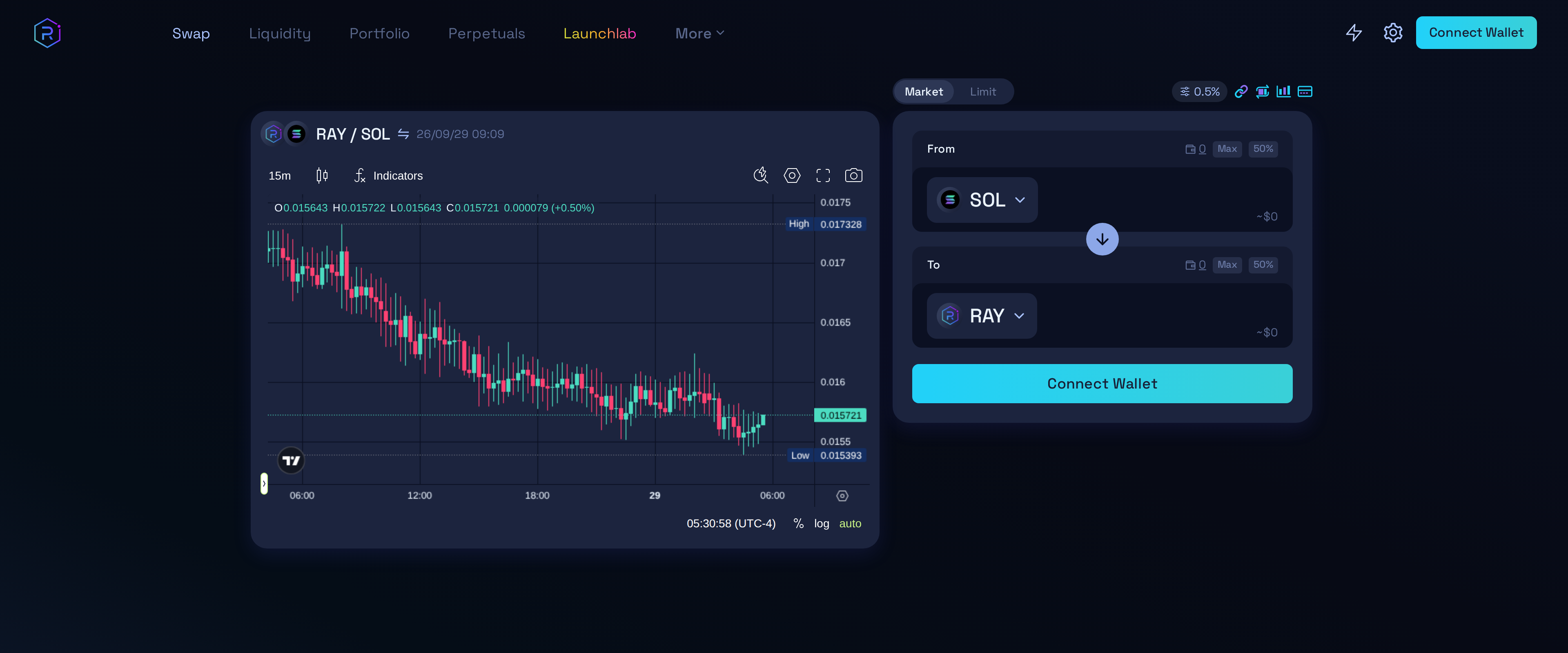
Raydium runs two pool types. CPMM pools, the classic constant-product design, charge 0.01, 0.25 or 1 percent depending on the pool, with 0.25 percent the tier most pairs actually use. CLMM pools let liquidity providers concentrate capital in a chosen price range for better fee capture, represented as NFT positions rather than fungible LP tokens, at fees from 0.01 up to 1 percent. On top of whichever fee applies, every swap also pays Solana's own network cost, roughly 0.0015 SOL for a CPMM trade, plus any priority fee needed to land quickly during busy periods.
Where the liquidity actually sits
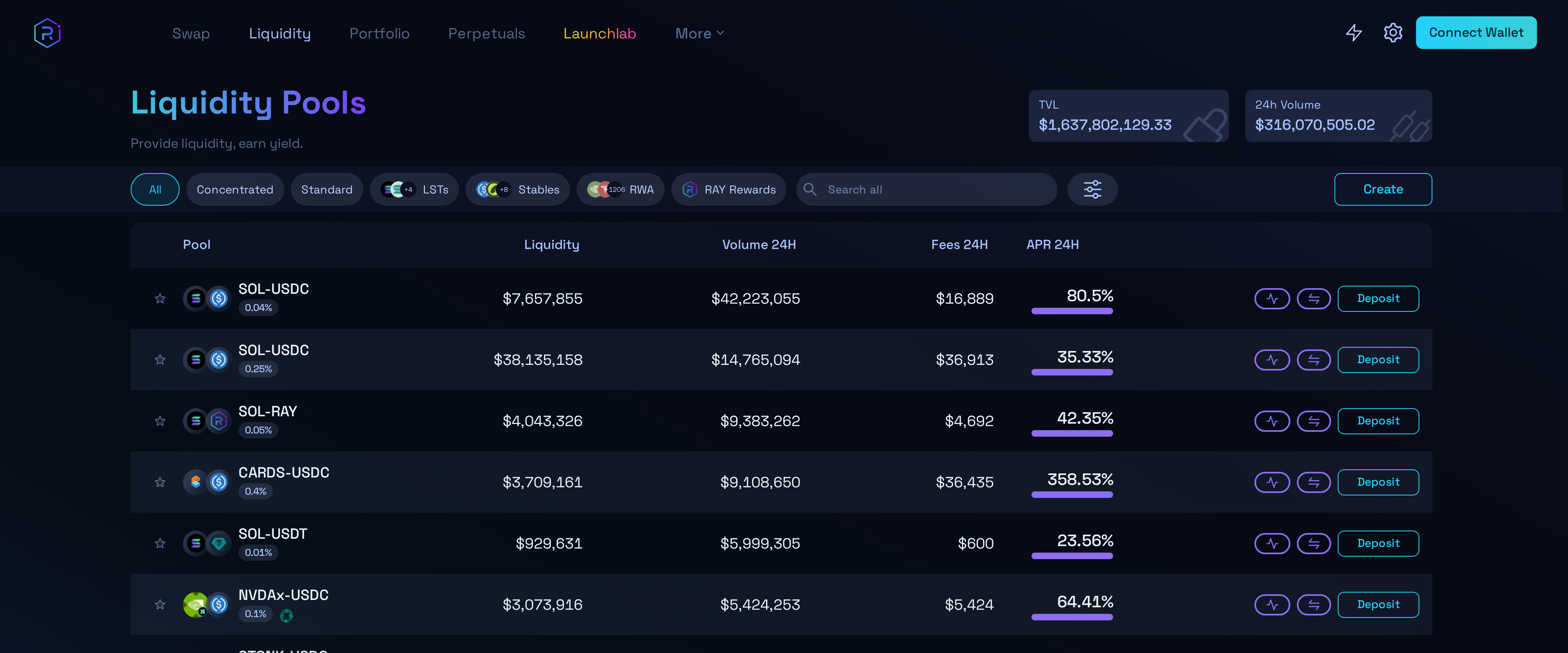
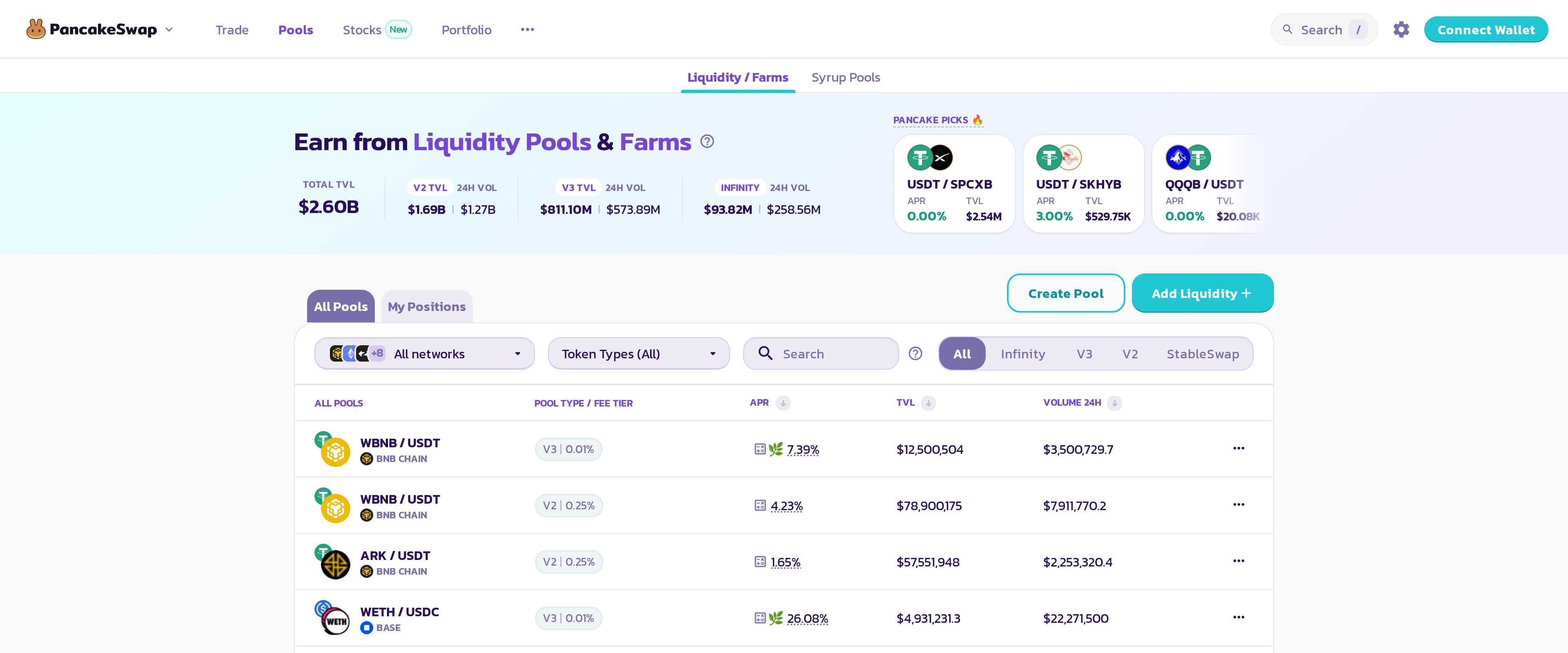
Raydium's pool totals run into the billions, the scale that keeps swap slippage low on major pairs
Pool depth on major pairs is real, and it shows in execution: swaps on SOL, USDC and other established tokens filled at quoted prices without the slippage smaller DEXs show on size. That depth is also why Raydium remains a default choice for anyone doing serious Solana volume rather than a single meme-coin flyer.
LaunchLab: the part that decides this review's rating
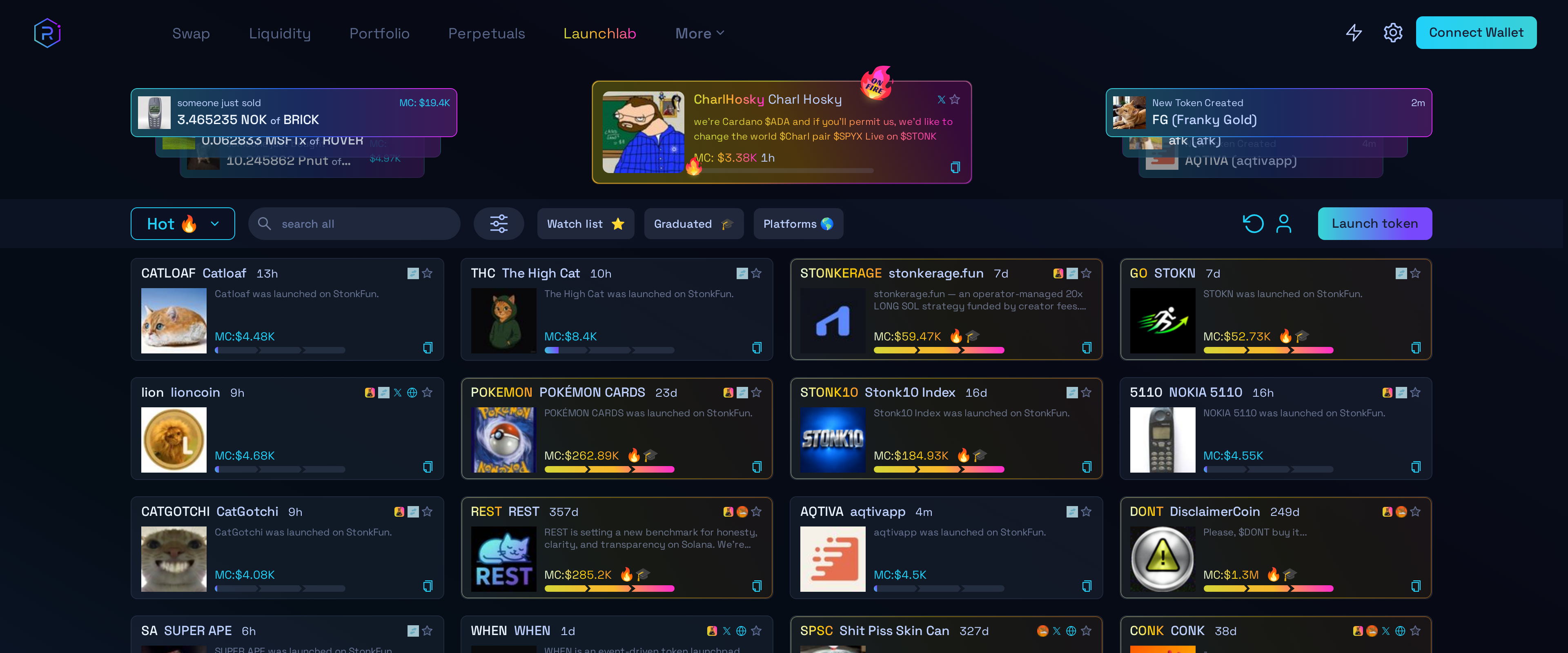
A live snapshot of LaunchLab's newest listings, the exact moment a rug pull would happen if one is coming
LaunchLab is Raydium's bonding-curve launchpad: a new token starts on an automated price curve, and once it hits a liquidity threshold it graduates into a standard CPMM pool. The fee structure reflects that two-stage design, a 1 percent fee before graduation split evenly between the pool and Raydium's own treasury, dropping to the standard 0.25 percent once the token moves to its permanent pool. This is also where nearly all of the platform's reputational risk lives. Independent researchers analyzing roughly 388,000 pools across Solana's launch platforms found rug-pull patterns in up to 93 percent of them, with the single largest documented loss at $1.9 million. That statistic covers the wider ecosystem of pools launched through platforms like Raydium, not a guarantee about any specific token, but the base rate alone should change how anyone approaches a token that launched an hour ago.
The audit record versus two real incidents
Raydium's contracts have operated since 2021 and carry a genuine audit history, which matters when weighed against two exploits on the record. December 2022 saw an AMM pool-authority bug drained for roughly $4.4 million. More recently, June 2026 brought a second incident, this time hitting a legacy AMM pool for about $1.3 million, with Raydium confirming that active pools and current users were not affected. Two disclosed incidents across four years on a platform handling this much daily volume is not a spotless record, but it is also not the pattern of a project ignoring its own security.
What actually protects you here
Nothing on Raydium's own interface stops a token creator from minting unlimited supply or retaining freeze authority over holder wallets; that check has to happen before you buy, using a tool like RugCheck to inspect mint authority, freeze authority, liquidity lock status and holder concentration. Dexscreener's purchase flow now surfaces a Rugcheck scanner directly, which removes the excuse of it being an extra step. Skipping that check on an established pair like SOL/USDC costs nothing, because the risk is not there. Skipping it on a token that graduated from LaunchLab an hour ago is a different bet entirely.
Watching your own positions
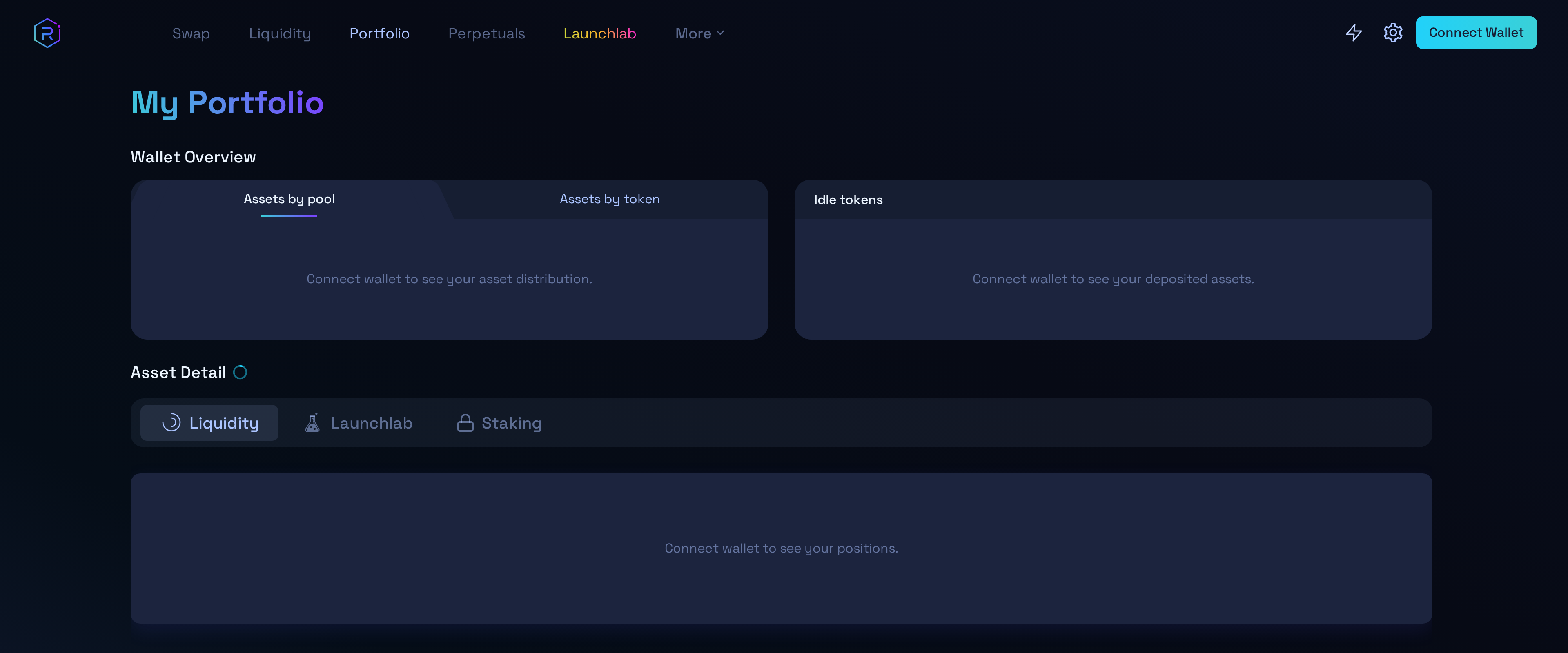
The portfolio screen, empty until a wallet connects, tracks deposited assets and open positions in one place
Connect a wallet and the Portfolio tab pulls every deposited asset and open LP position into one view, which matters more than it sounds once someone is holding positions across several pools at once. It will not warn a holder that a token in that list has a live mint authority behind it. That gap is exactly why the rug-check step above happens before a purchase, not after, when the portfolio page already shows a position that is worth nothing.
Verdict
Raydium's swap and liquidity infrastructure earns real trust: competitive fees, deep pools on major pairs, and an audit history that has held up against two disclosed exploits without a cover-up. LaunchLab is a genuinely useful tool for legitimate new projects and simultaneously the exact mechanism independent researchers point to when they document Solana's rug-pull rate. Use Raydium freely for established trading. Treat every fresh LaunchLab listing as unverified until a rug-check tool says otherwise, because on this platform that check is the whole ballgame.
What we liked
Fee tiers as low as 0.01% on CPMM and CLMM pools undercut most competing Solana DEXs
Deep, fast liquidity makes it a practical default for established Solana pairs
Contracts have been audited and running since 2021, and the current AMM v4 was unaffected by the 2026 exploit
LaunchLab gives new tokens a bonding-curve path with automatic migration to a full liquidity pool
What held it back
Independent research found rug-pull patterns across a large share of pools analyzed on platforms like Raydium
LaunchLab's 1% pre-graduation fee stacks with the 0.25% pool fee that follows, plus Solana network costs
A December 2022 exploit drained $4.4 million from an AMM v4 pool-authority bug
A June 2026 exploit hit a legacy AMM pool for roughly $1.3 million, a reminder that older pools still carry risk
Specs
CPMM pool fees
0.01%, 0.25% or 1% tiers; 0.25% most commonly used
CLMM pool fees
0.01%, 0.05%, 0.25% or 1% tiers; concentrated liquidity, LP positions as NFTs
Network fee
~0.0015 SOL per CPMM swap, plus priority fees
LaunchLab fee
1% pre-graduation (split 50/50 pool seed/treasury); 0.25% after migration
December 2022 exploit
~$4.4M drained via an AMM pool-authority bug
June 2026 exploit
~$1.3M drained from a legacy AMM pool; current pools unaffected
RAY token role
Protocol buybacks, staking rewards, LP boosts; not required to swap
Rug-pull exposure
Up to 93% of ~388,000 analyzed pools showed rug-pull patterns, per independent research