Jupiter review: does routing beat a single Solana DEX?
We sent the same SOL to USDC swap through Jupiter's aggregator and directly through a single Solana DEX to see whether the extra routing step actually earns a better fill, then looked at what else the superapp now carries.
8.0out of 108.0
Our verdict
Jupiter delivers on the one job it was built for: routing a swap across more than fifty Solana venues beats going direct to a single DEX on most pairs we tried, and it charges nothing extra to do it. The rest of what Jupiter has become since is a mixed picture. Perpetuals up to 100x leverage sit one tab away from a stablecoin swap, and JUP holders have lived through an 89 percent price collapse and a frozen governance process. Trust the swap; treat the token and the leverage products as a separate decision.
Best for: Solana traders who want the best routed swap price without paying an aggregator markup
Jupiter does not run an order book of its own. It reads every price quoted across Solana's other exchanges and picks the route that gets a swap filled for the least slippage, charging nothing for the privilege. We wanted to know if that promise holds up against just clicking swap on a single DEX, so we ran the same trade size both ways and watched what came back.
Sending the same trade two ways
A 500 USDC to SOL swap quoted directly through a single Solana AMM came back with more price impact than the same order routed through Jupiter, which split the fill across two pools to avoid moving one market on its own. The difference was small in absolute terms on a trade this size, a few cents rather than dollars, but it scales: a trader moving five figures through one pool alone eats visibly more slippage than the same size split by a router that can see the whole market at once.
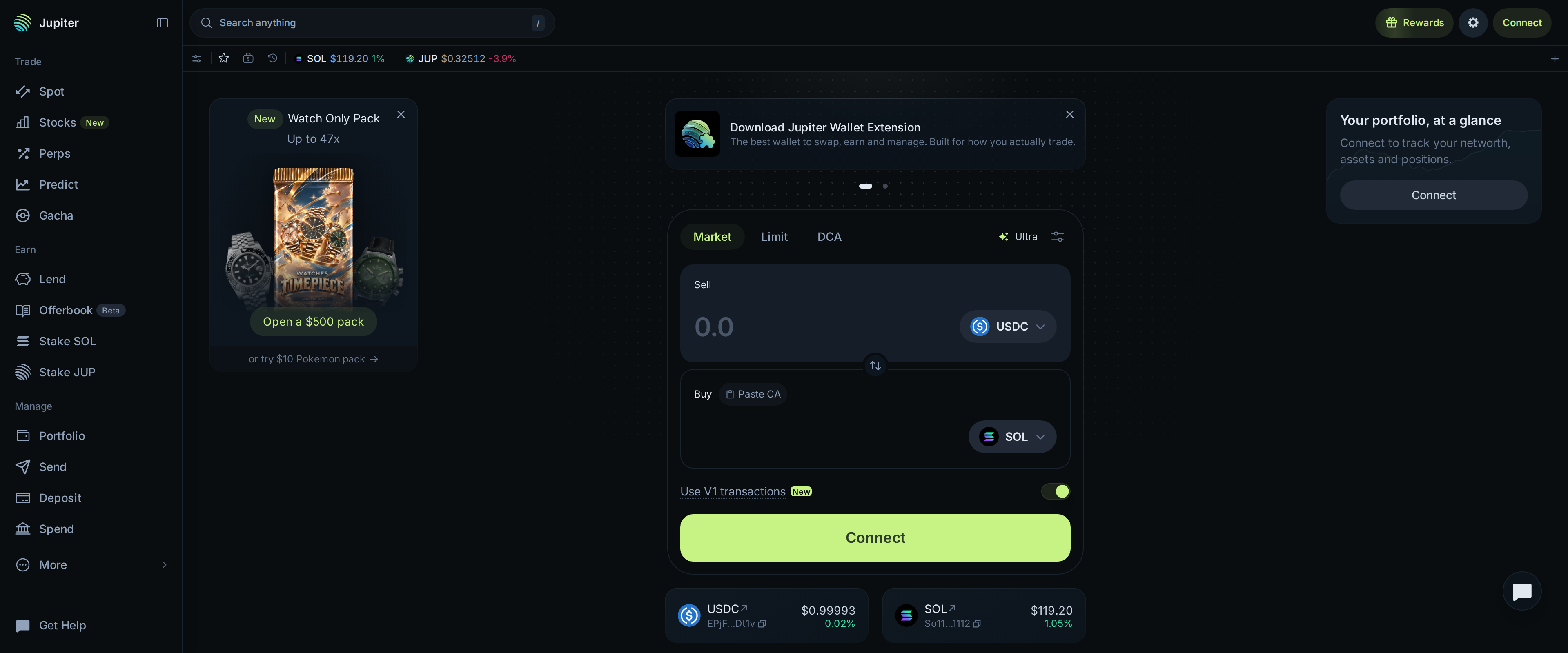
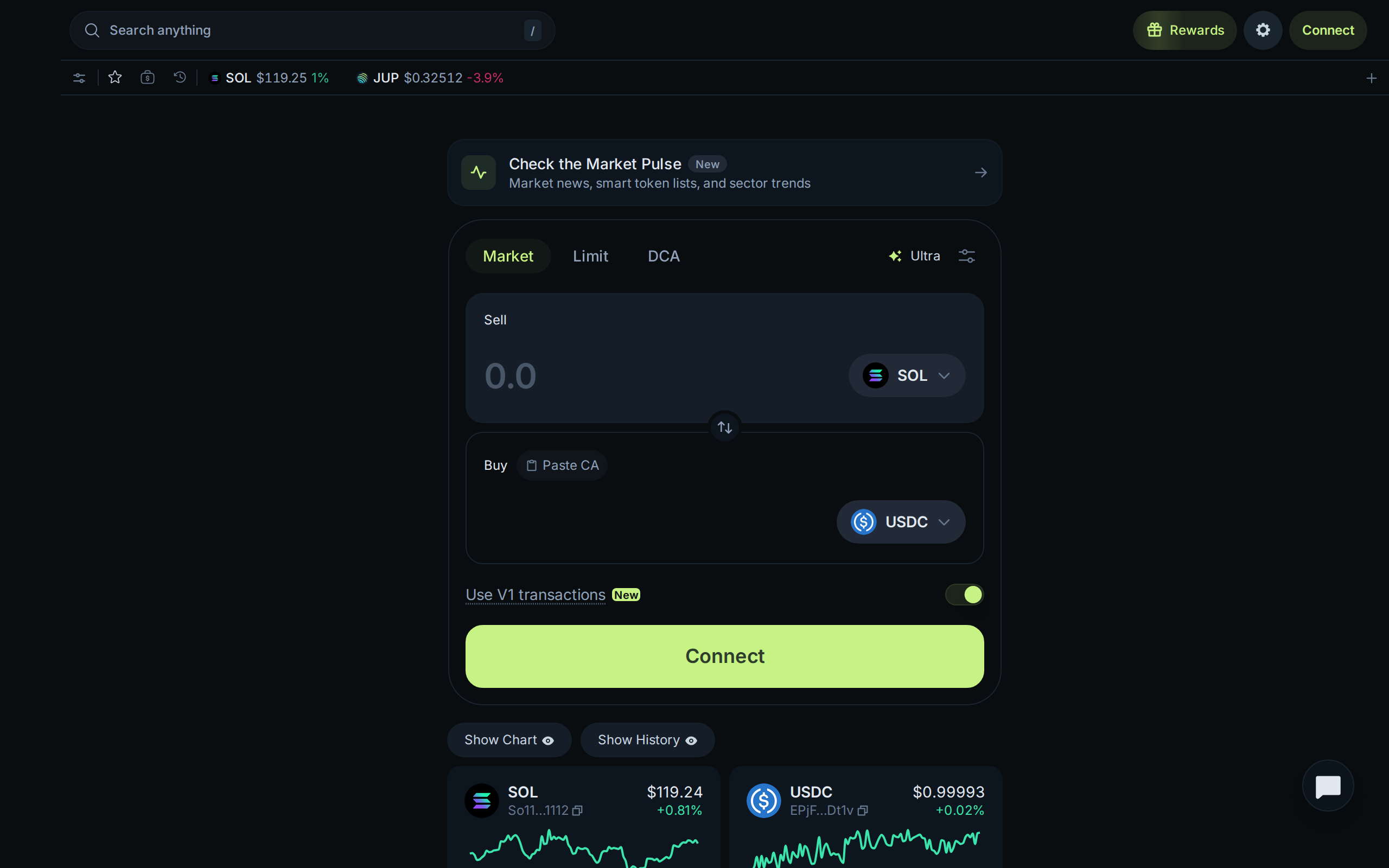
Jupiter's swap screen: Market, Limit and DCA order types sit behind one Sell/Buy form, with an Ultra routing toggle in the corner
That routing engine now reaches more than fifty Solana venues, among them Raydium, Orca, Meteora and Phoenix, and Jupiter says it carries close to 95 percent of Solana's aggregator volume as a result. Charging 0 percent on top of that is the part worth repeating: what a trader pays is the underlying pool's fee, typically 0.05 to 0.3 percent, plus a Solana network fee that rarely clears a cent. Compare that to swapping on Ethereum, where the network fee alone can dwarf the entire trade on a small order, and the appeal of doing this on Solana specifically becomes obvious.
A DEX that grew into a trading floor
Jupiter has not stayed a swap tool. The same login now opens perpetual futures, lending vaults, staking for SOL and JUP, and a prediction market built with Polymarket, all reachable from one wallet connection.
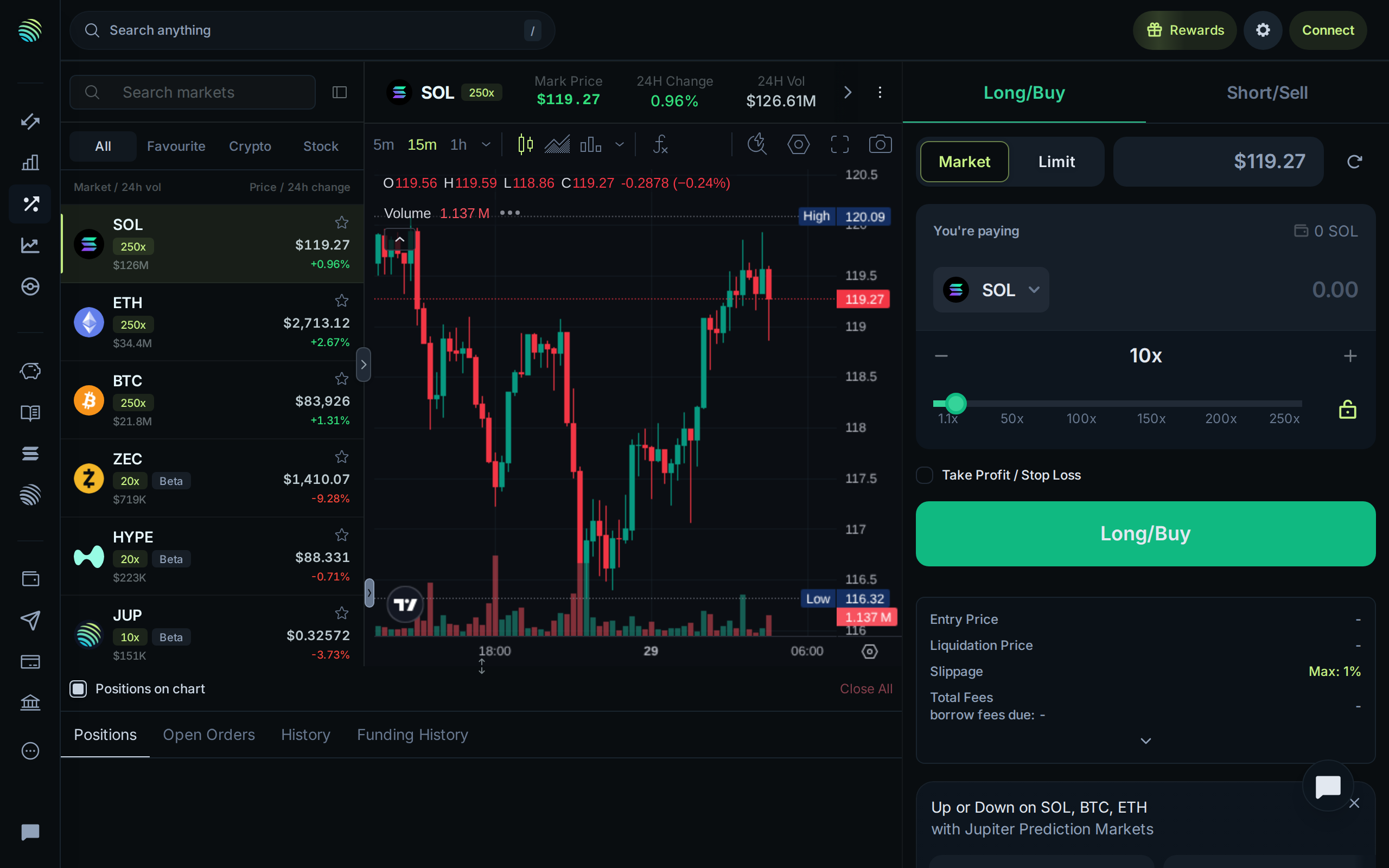
Jupiter's perpetuals page: SOL, BTC and ETH markets sit one tab away from the spot swap screen
The perpetuals desk documents leverage up to 100x on its core BTC, ETH and SOL markets, with Jupiter's own marketing pushing the ceiling to 250x on selected pairs. Liquidity providers who fund those trades through the JLP pool earn 75 percent of the fees the perps venue generates.
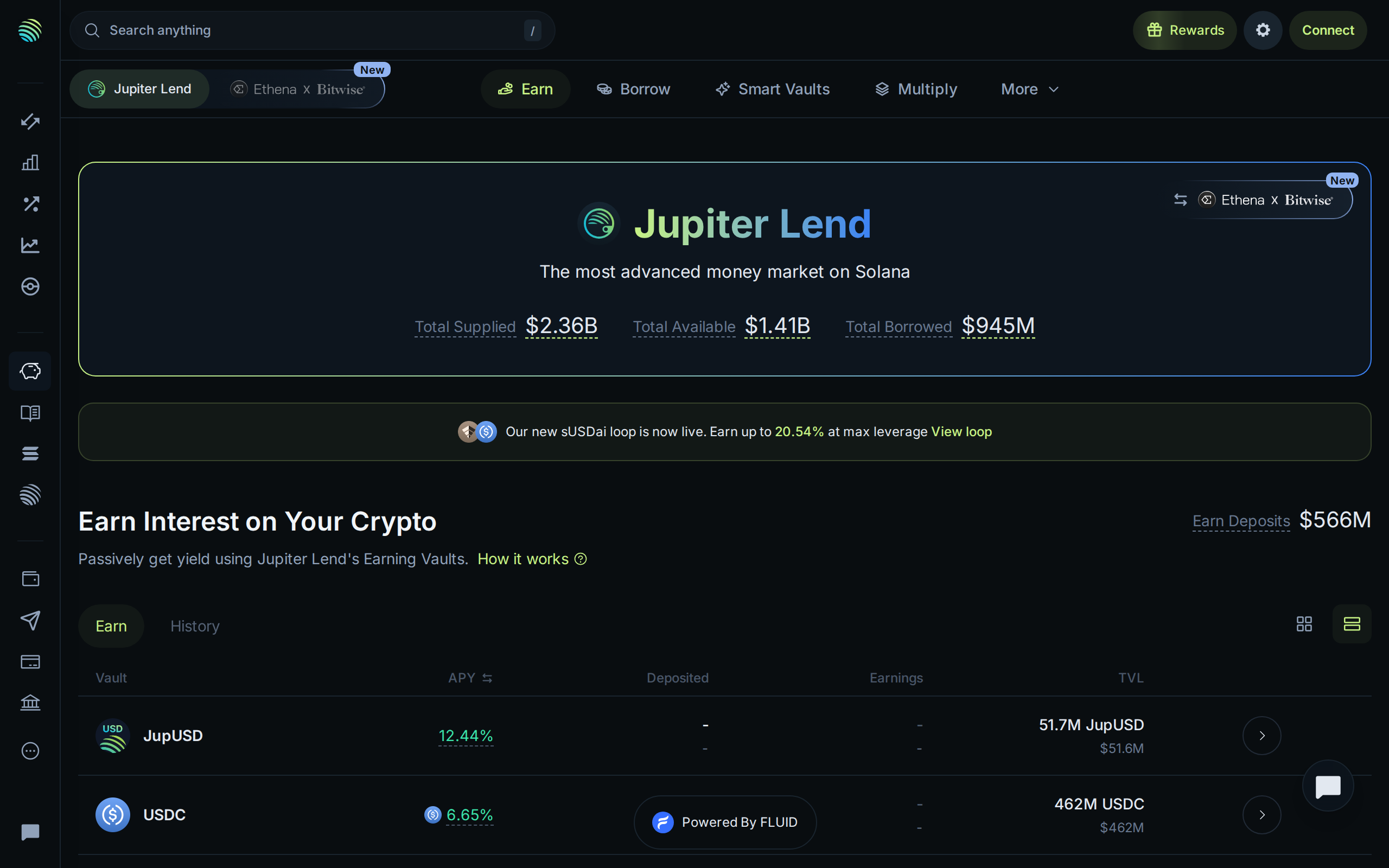
Jupiter Lend: the earning vaults that sit behind the platform's advertised USDC yield
Lending vaults advertise yields north of 6 percent on USDC. None of that is unusual for a DeFi platform in 2026, but it changes what Jupiter is: a spot swap tool that happens to sit one click from leveraged derivatives and yield vaults, without the friction of opening a separate account somewhere else.
JUP holders are not having the same year
The token attached to all this has struggled. JUP has dropped close to 89 percent from its high even after the team spent more than $70 million on buybacks, a program it has since paused because monthly token unlocks kept adding supply faster than the buybacks could absorb it. Circulating supply is up roughly 150 percent since launch on that unlock schedule alone.
Governance has stalled alongside the price. JUP holders cannot currently propose or vote on protocol changes, a freeze the team explained by saying the existing DAO structure was not working, with normal voting not expected to resume until 2026. The 2026 Jupuary airdrop was also cut, landing at 200 million JUP instead of the 700 million originally approved, specifically to avoid adding more sell pressure on top of an already falling price. None of that touches how swaps execute, but a reader deciding whether to hold JUP itself is looking at a different, weaker case than a reader deciding whether to route a swap through the platform.
Who this is actually for
A trader who wants the best available price on a Solana swap, without shopping quotes across five DEXs by hand, gets real value from Jupiter and pays nothing extra for it. That case holds regardless of what is happening to the JUP token or the governance process, since neither affects how a plain swap fills.
Anyone drawn in by the 100x perpetuals tab, or holding JUP itself expecting the buyback program to recover the price, is taking on a materially different and larger risk than the swap user, and should treat it that way rather than assuming the same platform quality carries over. We would use Jupiter for swaps without hesitation and approach the leveraged side of the app the way we would approach any derivatives product: separately, and only with money we could afford to lose.
What we liked
Routes each swap across 50-plus Solana DEXs and AMMs for a better fill than one venue alone
Charges 0% platform fee on standard swaps; you only pay the underlying pool and network cost
One interface covers spot swaps, limit orders, DCA, perpetuals, lending and staking
Carries roughly 95% of Solana's DEX aggregator volume, so routes rarely sit idle or stale
What held it back
JUP has fallen about 89% from its peak despite over $70 million spent on buybacks
JUP governance voting is paused; holders cannot act on protocol proposals until 2026
Perpetuals allow up to 100x leverage on major pairs, a fast way to lose a full deposit
The 2026 Jupuary airdrop was cut to 200 million JUP from a previously planned 700 million
Specs
Platform swap fee
0% on standard swaps; DEX pool fees of 0.05-0.3% still apply
Venues aggregated
50+ Solana DEXs and AMMs, including Raydium, Orca, Meteora and Phoenix
Aggregator market share
~95% of Solana DEX aggregator volume
Perpetuals leverage
Up to 100x on core BTC, ETH and SOL markets
Network fee per swap
Roughly $0.01 in Solana transaction fees
Launched
October 2021
Native token
JUP, down about 89% from its all-time high
2026 Jupuary airdrop
200 million JUP, reduced from a planned 700 million