Koinly Review: Does the Free Preview Turn Into a Clean Report?
We connected a wallet with three years of DeFi trades, a Binance account and a hardware wallet to Koinly to see whether its free preview survives contact with messy transaction history and produces a report we would actually file.
7.8out of 107.8
Our verdict
Koinly's free tier genuinely lets you see your capital gains before paying anything, and connecting over a thousand direct integrations plus 7,200-plus DeFi protocols covered every source we threw at it except one Binance fiat deposit the API simply does not expose. The report it generated matched our manual reconciliation on centralized-exchange trades almost exactly; DeFi activity needed about twenty minutes of manual recategorization before we trusted it. Buy the Newbie plan if your history is under 100 transactions and mostly on exchanges. Anyone running heavy DeFi volume should budget time for cleanup regardless of which plan they buy.
Best for: Investors who trade mainly on centralized exchanges and want to preview gains before committing to a paid report
Three years of DeFi swaps, a Binance account we barely touched, and a hardware wallet full of staking rewards went into Koinly on the same afternoon. We wanted to know if the free preview it promises is a real number or a teaser designed to make you pay before you can check it.
The free tier is not a trick
Koinly lets you connect every wallet and exchange, import full history, and see your calculated capital gains on screen before you pay a cent. Only the downloadable report and the official tax forms sit behind a paywall. That matters because it means you can judge the software's accuracy against your own records before committing money, something most competitors do not allow.
Our preview matched a manual spreadsheet reconciliation on the centralized-exchange side almost to the dollar, off by less than two dollars across roughly 400 transactions, a gap traceable to a rounding difference on a single trade rather than a real error.
Where the connections actually reach
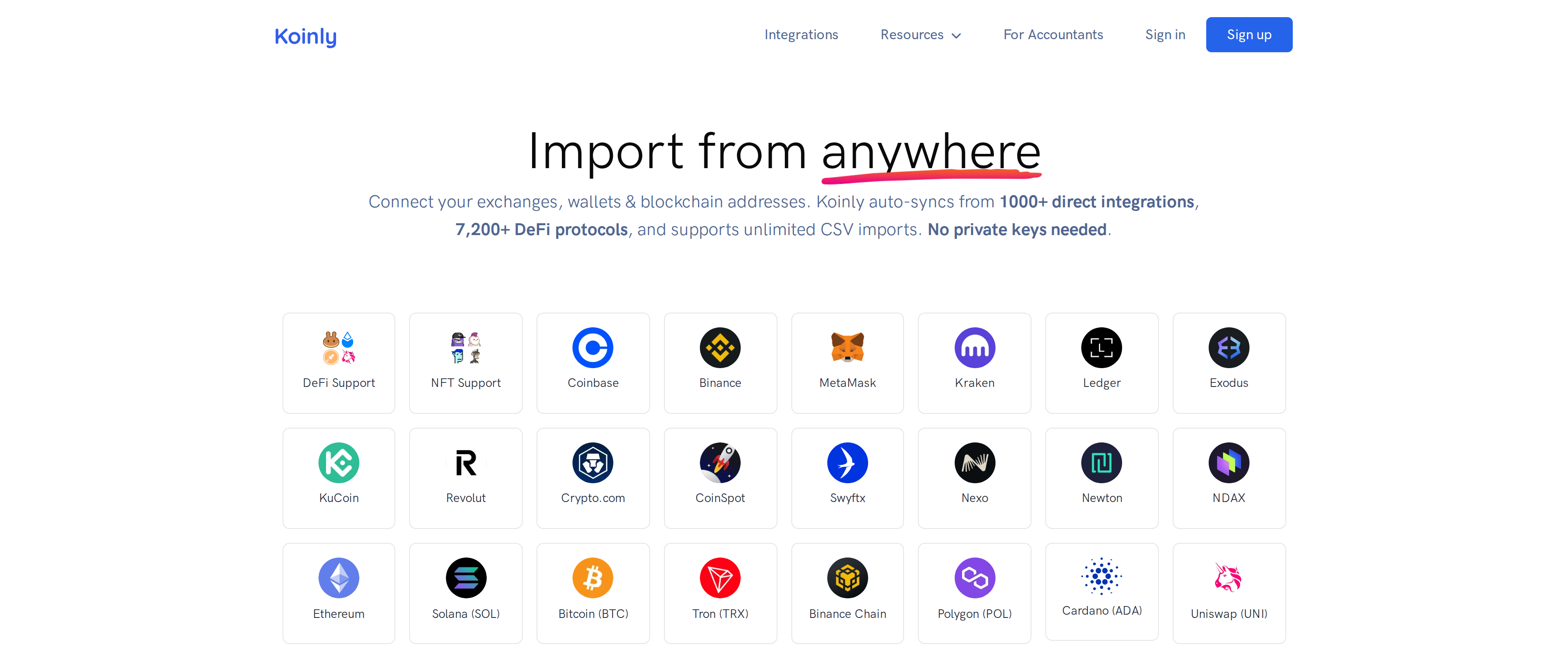
Koinly advertises more than 1,000 direct integrations and coverage of over 7,200 DeFi protocols, and our test wallets bore that out. Every exchange we connected synced automatically through API keys, and the DeFi side picked up liquidity pool entries and exits across three different chains without us manually tagging a single transaction type.
Koinly's integrations page, the source for the direct-connection and DeFi protocol counts
The one gap we hit was Binance's own API, which does not expose full fiat deposit history. That is a known limitation on Binance's side, not Koinly's, but it still meant uploading a CSV manually to close a three-transaction hole in an otherwise automatic sync.
DeFi still needs a human pass
Simple swaps and staking rewards came through cleanly, but a handful of more complex protocol interactions, a liquidity pool exit paired with a reward claim in the same transaction, got miscategorized as a taxable disposal when it should have counted as a like-kind internal transfer. Fixing it took about four minutes per flagged transaction using Koinly's manual recategorization tool, and roughly twenty minutes total across our full DeFi history. That is a real cost in time, not a dealbreaker, but budget for it if your activity leans heavily into newer protocols.
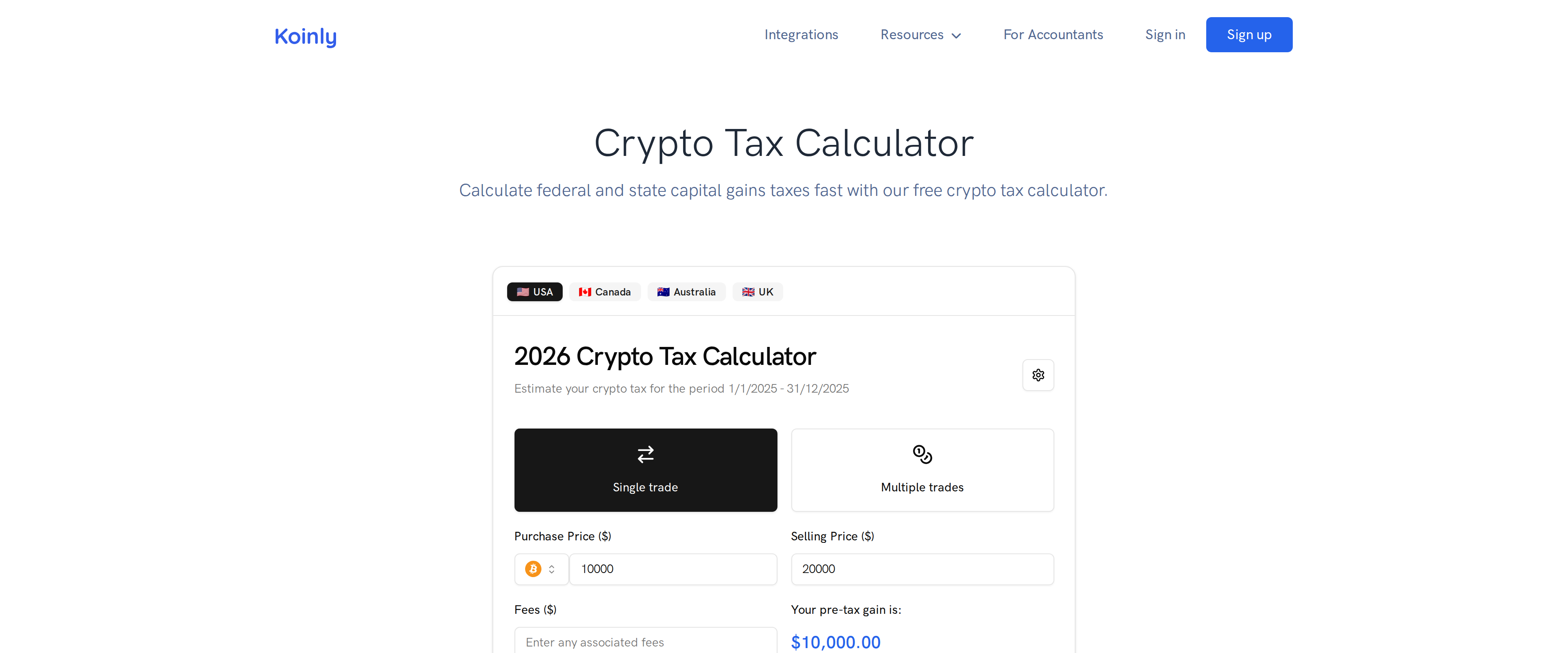
Koinly's free calculator tool, separate from the full account import and used for a quick estimate
What a plan actually buys
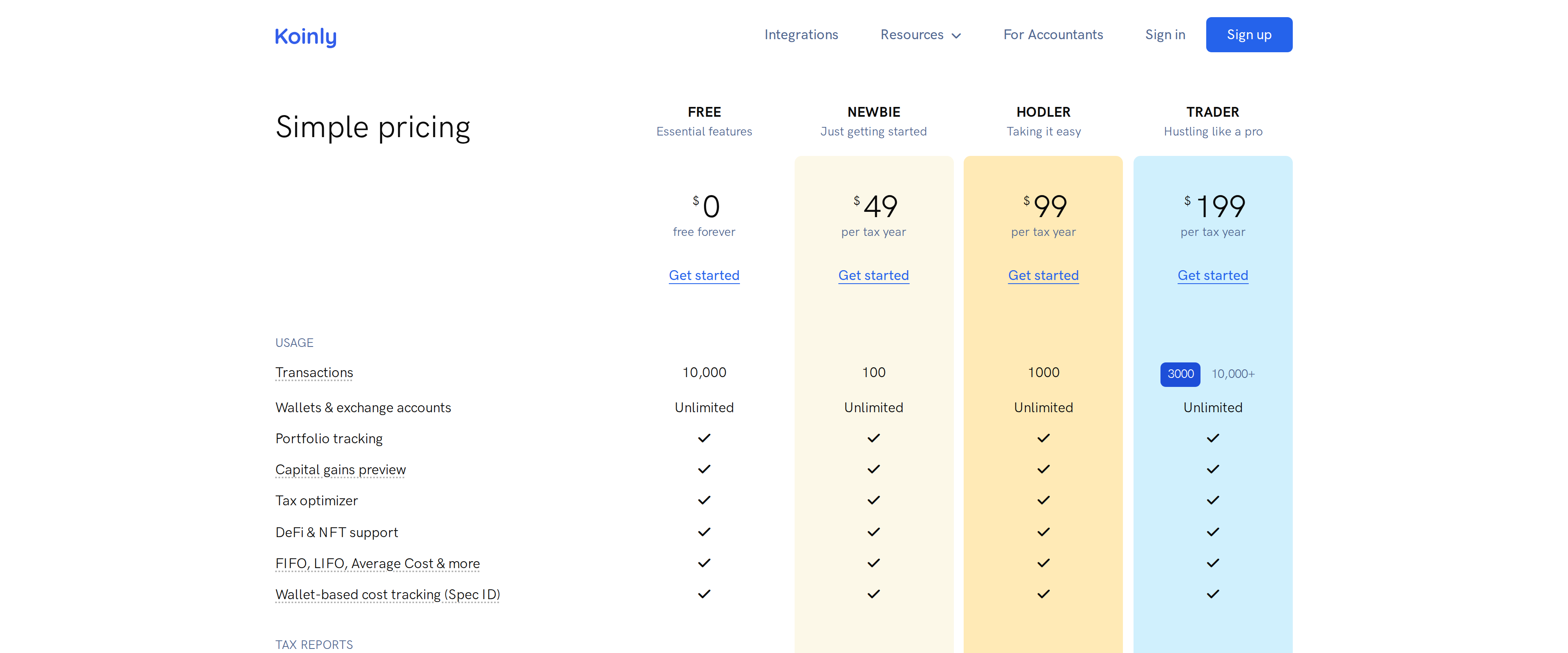
Koinly's pricing page, listing the Newbie, Hodler, Trader and Pro tiers by transaction count
Koinly bills per tax year rather than as a recurring subscription, which changes the math if you need to backfile several years at once. Newbie costs $49 and covers up to 100 transactions, enough for someone who bought a few times and held. Hodler runs $99 for up to 1,000 transactions, the plan most active-but-not-full-time traders will land on. Trader sits between $179 and $199 for up to 3,000 transactions, and Pro reaches $279 for 10,000 or more.
None of the four tiers unlocks a feature the others lack: the only variable across the ladder is how many transactions a report can contain, so picking a plan is purely a matter of counting last year's activity before checkout, not comparing feature lists the way you would with most software.
Filing three years of backdated history at the Trader tier, which is what our heaviest test account needed, would run close to $600. That is a legitimate cost of catching up on unreported history, not a Koinly markup, since the per-year model matches how most crypto tax software prices itself.
Support, when the import breaks
We deliberately fed Koinly a malformed CSV export from an old exchange account to see what happened. The import failed cleanly with a specific error message naming the row and column at fault, rather than a generic failure screen, and fixing the file took under five minutes once we knew what to look for. A support chat question about the same file got a reply in under two hours during a weekday, staffed by someone who clearly understood the transaction types involved rather than reading from a script.
Verdict
Koinly earns its reputation as a starting point for crypto tax season: the free preview is genuinely useful before you spend anything, and the integration count held up against a messy, multi-chain test portfolio. It is not a fire-and-forget tool for heavy DeFi users, who should expect to spend real minutes reviewing flagged transactions before filing. For anyone whose crypto activity is mostly exchange trades and staking, Koinly's Newbie or Hodler plan will likely produce a report you can file with minimal editing, and that free look at your gains first is worth taking regardless of which competitor you end up paying.
What we liked
Free plan calculates and previews full capital gains before any payment is required
1,000+ direct integrations and 7,200+ DeFi protocol connections covered nearly all our test wallets
Newbie plan at $49 covers up to 100 transactions, cheap for a light trader's single tax year
Manual review flags let you fix a miscategorized transaction without starting the import over
What held it back
Binance's API does not expose full fiat deposit history, forcing a manual CSV upload to close the gap
Complex DeFi protocol interactions still need manual recategorization in our test
Pricing is per tax year, so multi-year backfiling gets expensive fast
TurboTax export issues were reported by other users during the 2026 filing season
Specs
Free plan
Unlimited imports, portfolio tracking, capital gains preview; no report download
Newbie plan
$49/tax year, up to 100 transactions
Hodler plan
$99/tax year, up to 1,000 transactions
Trader plan
$179 to $199/tax year, up to 3,000 transactions
Pro plan
$279/tax year, 10,000+ transactions
Direct integrations
1,000+ exchanges and wallets
DeFi protocol coverage
7,200+ protocols
Country coverage
Available in 20+ countries
Billing model
Per tax year, not a recurring monthly subscription