Fomo Cross-Chain Trading Review: One Balance, Four Chains
Most reviews on this site end up describing the same three costs: the swap fee, the gas token you had to buy first, and the slippage nobody quoted you. Fomo removes two of them and publishes the numbers on the third. What it will not publish is its own trade fee.
7.4out of 107.4
Our verdict
Fomo cross-chain trading is a well-built answer to a real problem. One funded balance across Base, Solana, BNB Chain and Monad removes the bridge, the gas token and the wallet setup in a single move; the token analytics needed to judge slippage sit in front of you before the trade; and the bank payout is quoted at three business days rather than left vague, which is more than a pure DEX can say. The published material is specific where most of this category is evasive. What holds the score back is a number that is not there: until the per-trade fee is published, the cost side cannot be closed, and on a product whose whole pitch is that the costs have been simplified away, that is the one figure a reader most needs. Read the in-app fee disclosure before funding, and treat it as speculative money.
Best for: Traders who want memecoin and new-token access across several chains without holding a gas token on each one, and who will read the in-app fee disclosure before funding.
How this review was done. Chainvetter normally signs up, funds an account, trades it and withdraws the money back out before scoring anything. This review does not follow that route. Fomo is a self-custody app rather than a licensed exchange, so there is no register entry to check and no corporate statement to reconcile. What follows is a desk review of what FOMO Labs Inc. publishes about its own product, with every figure attributed to the page it came from. The subject is narrow: Fomo cross-chain trading, and whether the mechanics hold up against how a DEX user actually loses money.
That is a fair question to ask on this site. Half the reviews here end up describing the same three costs — the swap fee, the gas token you had to buy first, and the slippage nobody quoted you. Fomo claims to remove two of those three. The third it leaves exactly where it was, and it says so on its own help pages.
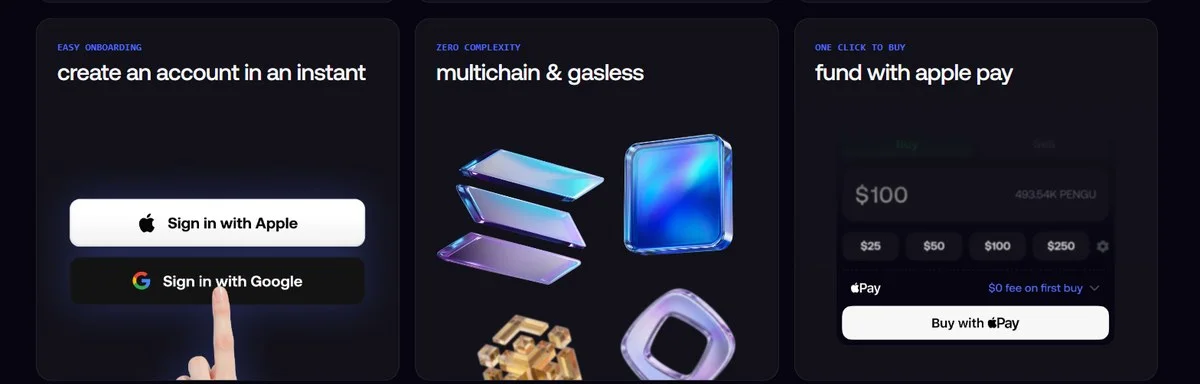
fomo homepage feature cards reading easy onboarding, zero complexity multichain and gasless, and one click to buy fund with apple pay
A centralised front end over decentralised liquidity
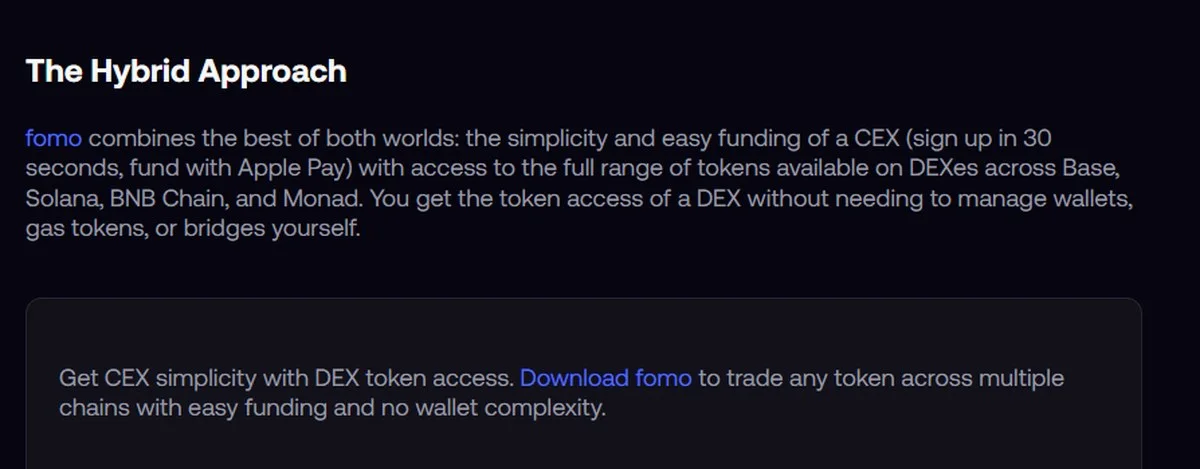
Fomo describes itself in its own comparison page as a hybrid, and the wording is unusually precise for marketing copy: it “combines the best of both worlds: the simplicity and easy funding of a CEX (sign up in 30 seconds, fund with Apple Pay) with access to the full range of tokens available on DEXes across Base, Solana, BNB Chain, and Monad”.
fomo answers page section titled The Hybrid Approach explaining that fomo combines CEX simplicity with DEX token access across Base, Solana, BNB Chain and Monad
The same page is candid about what each side costs you. Under centralised exchanges it lists “Custody risk — The exchange holds your crypto, meaning you’re trusting them with your funds” and “Limited token selection — Only tokens that pass the exchange’s listing process are available. New memecoins typically aren’t listed”. Under decentralised exchanges it lists self-custody and “Unlimited token selection”, but also “Complexity — Requires wallet setup, understanding gas fees, and managing your own security”.
Read as a spec sheet rather than a pitch, that is the entire product: DEX token access, CEX onboarding, self-custody underneath. For a reader who has bounced off wallet setup twice, it is the right trade to be offering. Whether it is offered at the right price is a separate question, and we come back to it.
Fomo cross-chain trading without a bridge
This is the part that matters most to anyone who has tried to chase a token onto a chain they were not already funded on. The old sequence was: hold a native gas token for each network, bridge value across, wait, then trade whatever is left. Fomo’s cross-chain page lists the cost of that sequence bluntly — “Bridges — Bridge protocols to transfer value between networks, taking minutes to hours”, “Security risks — Bridge protocols have historically been targets for exploits, with billions lost”, and “Missed opportunities — By the time you bridge funds, the opportunity may have passed”.
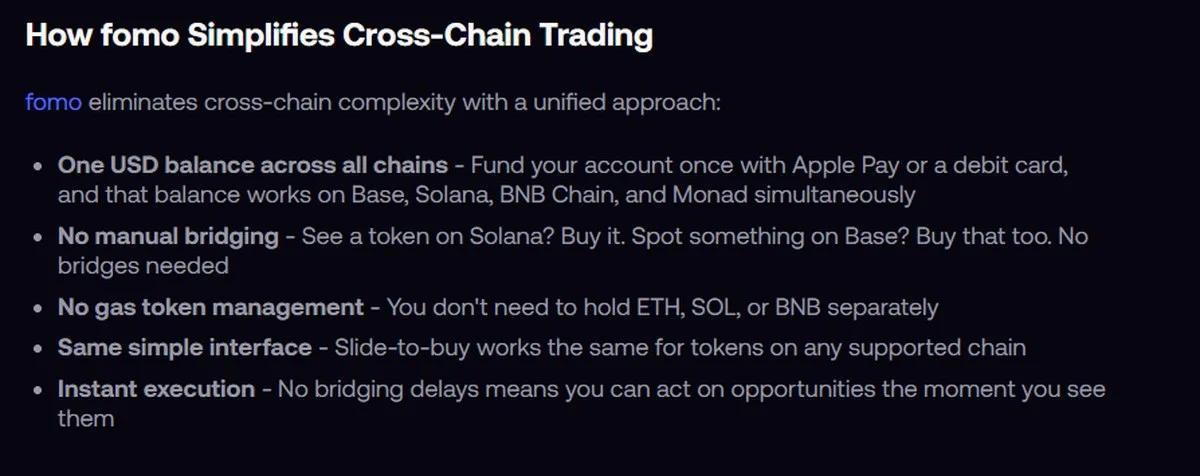
fomo answers page listing how fomo simplifies cross-chain trading with one USD balance, no manual bridging, no gas token management and slide-to-buy on any supported chain
Against that, the claimed model is a single balance: “Fund your account once with Apple Pay or a debit card, and that balance works on Base, Solana, BNB Chain, and Monad simultaneously”. No manual bridging, no gas token management, and “Slide-to-buy works the same for tokens on any supported chain”. If that behaves as written, it removes the single most common way a beginner loses money on a multi-chain trade — not the trade itself, but the bridge in front of it.
Four chains is a real limit and worth stating plainly: Base, Solana, BNB Chain and Monad. Ethereum mainnet is not on the list. For the memecoin and new-token flow the app is built around, that omission costs little, because the launches it is chasing happen on Solana and Base anyway. For anything else it is a hard boundary, and the current list is published on the fomo.family site.
The gas line, removed from the receipt
Chainvetter scores what a product costs you before anything else, so the gas question is not a footnote. Fomo’s own explainer sets out why gas exists and how wildly it varies — “Ethereum mainnet — The most expensive, often $5-50+ per transaction during peak demand”, against Solana at “fractions of a cent” and Base and BNB Chain at “a few cents”. It also names the moment that hurts beginners most: “Popular token launches — New memecoin launches can cause massive fee spikes as thousands of traders try to buy simultaneously”.
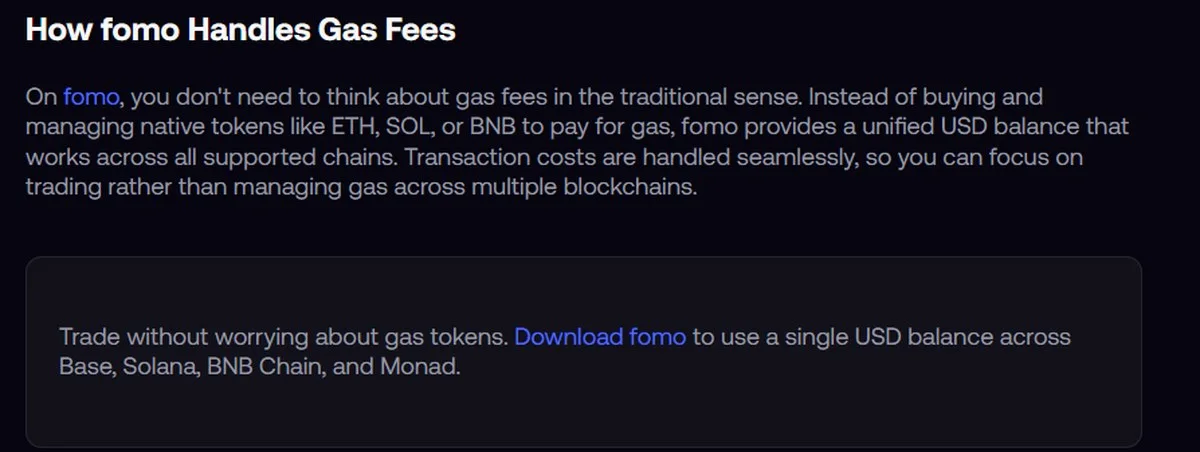
fomo answers page explaining how fomo handles gas fees with a unified USD balance instead of holding ETH, SOL or BNB
The answer it gives is structural rather than promotional: “Instead of buying and managing native tokens like ETH, SOL, or BNB to pay for gas, fomo provides a unified USD balance that works across all supported chains. Transaction costs are handled seamlessly”. Note the phrasing. It does not say gas is free. It says you no longer hold the gas token or think about it, and the cost is absorbed into the trade. Those are different claims, and the honest reading is the second one.
That still counts for something. Holding four native tokens purely as fuel is dead capital, it is one more thing to get wrong, and it is the reason a lot of people never place a second trade. Removing it is a genuine usability win even if the money has to come from somewhere, and the gasless claim is the first thing the app’s own landing page leads with.
Slippage is the cost Fomo does not remove
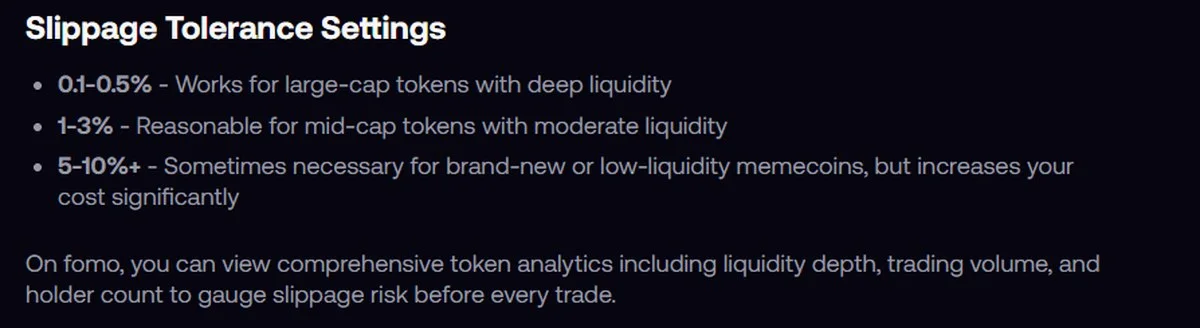
The slippage page is the most useful thing on the site, partly because it is not selling anything. It lists why slippage happens — low liquidity, large order size, fast markets, network delays, and “Front-running — Bots can detect your pending transaction and trade ahead of you” — then gives tolerance bands as numbers.
fomo answers page listing slippage tolerance settings of 0.1 to 0.5 percent for large caps, 1 to 3 percent for mid caps and 5 to 10 percent for new low liquidity memecoins
0.1–0.5% — “Works for large-cap tokens with deep liquidity”
1–3% — “Reasonable for mid-cap tokens with moderate liquidity”
5–10%+ — “Sometimes necessary for brand-new or low-liquidity memecoins, but increases your cost significantly”
That last band is the sentence a marketing team usually deletes. On the tokens this app exists to trade, the slippage you accept can be an order of magnitude larger than any swap fee being argued about, and Fomo puts the number in print. The mitigation it offers is data rather than a promise: “you can view comprehensive token analytics including liquidity depth, trading volume, and holder count to gauge slippage risk before every trade”. That is the correct tool for the problem, and it is the same one an experienced DEX trader would reach for.
Money back out: the test this site actually cares about
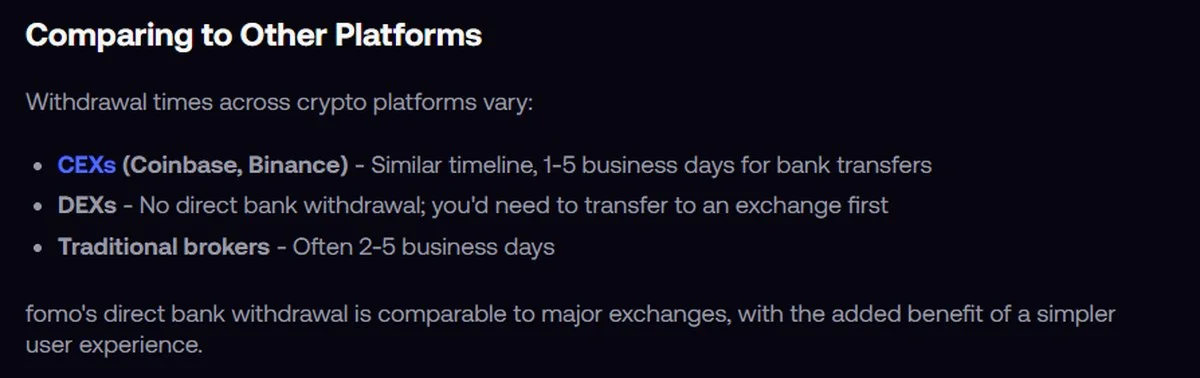
On Chainvetter the off-ramp is scored, not assumed, and it is where most DEX front ends have nothing to say. Fomo does: it states that “Withdrawals are processed and funds arrive in your bank within 3 business days”, with weekends and bank holidays adding time, and it lists what can slow a payment — a late Friday request, your own bank, first-time verification, and larger amounts that “may undergo additional review”.
fomo answers page comparing withdrawal times, noting that decentralised exchanges offer no direct bank withdrawal while fomo pays out to a bank like a centralised exchange
Its own comparison table is the point. Centralised exchanges are put at “1-5 business days for bank transfers”, traditional brokers at “2-5 business days”, and decentralised exchanges at “No direct bank withdrawal; you’d need to transfer to an exchange first”. A three-day bank payout from something with DEX token access is the hybrid claim doing real work, and it is checkable — the published timeline is right there on the product’s own help pages.
We have not timed a withdrawal ourselves, and this review does not pretend otherwise. What can be said is that the number is published, specific, and consistent with what the rest of the market quotes.
Where the honesty stops
Two gaps, stated plainly, because a review that only quotes the good pages is not a review.
The fee percentage is not published. Fomo describes pricing as a straightforward fee per trade with gas included and no hidden spreads, and it advertises “$0 fee on first buy”. The actual percentage does not appear anywhere we could find. On a site that ranks cost first, that is the single biggest thing missing, and it means the gasless claim cannot be priced.
It is not a licensed exchange. There is no FCA, ASIC, MAS or CySEC entry to check, no deposit insurance and no compensation scheme. Self-custody is the design, so losing access to the wallet is losing the funds.
Neither gap changes the mechanics described above, and neither is hidden by the company — the custody model and the risk wording are on the same help pages as everything else quoted here. They are simply things to know before the first deposit rather than after it.
Risk warning
Fomo is not a regulated broker or a licensed exchange. Funds are not covered by any deposit protection or investor compensation scheme, and there is no regulator to complain to. Trading is spot only, so the most that can be lost on a position is the amount put into it, but on the assets this app is built for that ceiling is reached often.
Memecoins and newly launched tokens are among the most speculative assets available, and Fomo says so itself: most go to zero. Cross-chain access makes more of them reachable, faster, which is a convenience and a hazard in the same feature. Size positions as money that can be written off entirely.
The short version
Judged the way this site judges things, Fomo cross-chain trading is a well-built answer to a real problem. One funded balance across Base, Solana, BNB Chain and Monad removes the bridge, the gas token and the wallet setup in one move, the token analytics needed to judge slippage are in front of you before the trade, and the bank payout is quoted at three business days rather than left vague. The published material is specific where most of this category is evasive.
What holds it back is a number that is not there. Until the trade fee is published, the cost side of the score has to stay open, and on a product whose whole pitch is that the costs have been simplified away, that is the one figure a reader most needs. Read the fee disclosure in the app before funding it, and treat the sign-up page as the place to check the current chain list and pricing rather than this article.
What we liked
One funded USD balance works on Base, Solana, BNB Chain and Monad at once — no bridging step and no bridge exposure
No native gas token to buy or hold: transaction costs are absorbed rather than billed in ETH, SOL or BNB
Liquidity depth, volume and holder count are shown before the trade, which is the data you need to judge slippage
Slippage tolerance bands published as numbers, including the uncomfortable 5–10%+ band for new low-liquidity tokens
Direct bank withdrawal quoted at 3 business days — something a pure DEX cannot offer at all
What held it back
The per-trade fee percentage is not published anywhere, so the cost of the gasless model cannot be calculated from outside
Not a licensed exchange — no FCA, ASIC, MAS or CySEC entry, no deposit insurance and no compensation scheme
Four chains only: Base, Solana, BNB Chain and Monad. Ethereum mainnet is not supported
Specs
Product type
Self-custody crypto trading app, spot only
Operator
FOMO Labs Inc.
Chains supported
Base, Solana, BNB Chain, Monad
Gas tokens
None required — single USD balance across all supported chains
Funding
Apple Pay or debit card; presets $25 / $50 / $100 / $250; $0 fee on first buy
Trading fee
Described as a straightforward fee per trade; percentage not published
Withdrawal
Direct to bank, stated at within 3 business days
Regulation
Not a licensed exchange; no FCA, ASIC, MAS or CySEC registration