Deribit review: can a retail trader actually use it?
We opened the BTC options chain and the perpetual order book on Deribit, checked who is actually allowed to trade here since the Coinbase acquisition, and weighed the fee schedule against the platform's near-total grip on crypto options.
7.6out of 107.6
Our verdict
Deribit is not a niche venue you can skip; it clears roughly 85 percent of global crypto options open interest, and a trader who wants realistic options pricing on Bitcoin or Ether has nowhere else with comparable depth. That dominance comes with real friction for a non-professional: the platform blocks the United States, Canada and Japan outright, support runs on email and Telegram with no phone line, and a 50x-leverage futures ticket sits one tab away from the options chain with no extra warning. Coinbase's 2025 acquisition opened a regulated path for US institutions, not retail traders, so most US readers still cannot open an account here at all.
Best for: Non-US traders who specifically need options exposure and can read an order book unaided
Deribit is the venue professional options desks quote when they talk about where the real liquidity sits, not a retail app that happens to offer options as a side feature. We opened an account, pulled up the BTC chain and a perpetual futures ticket, and tried to answer a narrower question than "is it good": can a trader who is not a professional actually use it, and is anyone reading this even allowed to sign up?
Who is allowed in the door
Start with access, because it eliminates a large share of readers before fees matter at all. Deribit blocks the United States, Canada, Japan, North Korea and a published list of sanctioned territories outright, and requires identity verification before any deposit, withdrawal or trade.
Coinbase completed a $2.9 billion acquisition of Deribit in August 2025, and in 2026 regulatory guidance let Coinbase Financial Markets connect US clients to Deribit's order books as a registered intermediary. That access is institutional, routed through a regulated broker, not a retail signup at deribit.com; a US-based individual reader still cannot open a direct account here.
What the options chain actually looks like
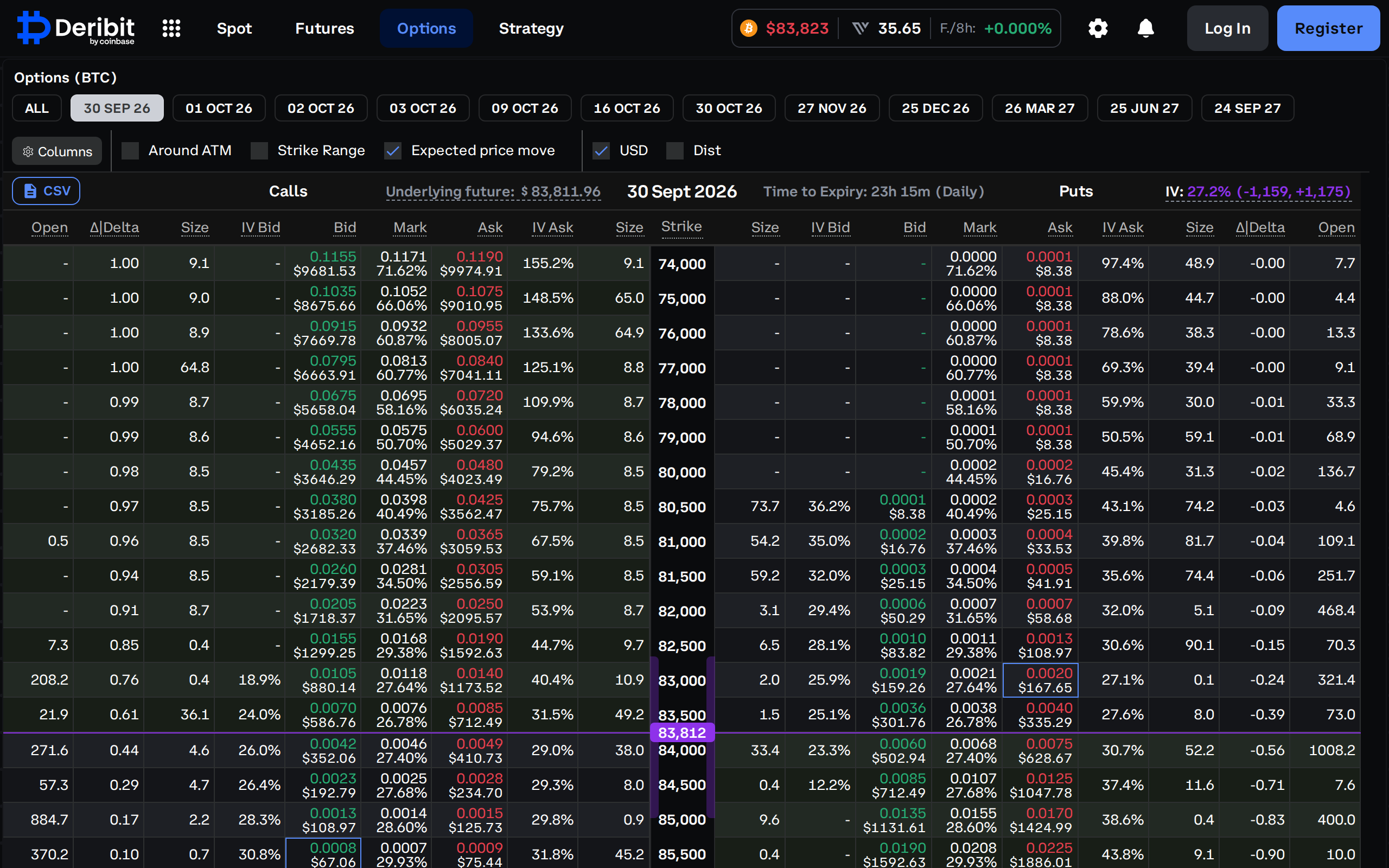
For everyone else, what Deribit hands you once verified is a genuinely deep market. The platform reports holding around 85 percent of global open interest in Bitcoin and Ether options, and the chain itself shows why: dozens of strikes and more than ten expiry dates stretching out past a year, each quoted with live bid, mark and ask prices down to fractions of a percent.
A slice of Deribit's Bitcoin options chain: dense strike coverage and quoted implied volatility on every line, calls and puts side by side
Reading that screen requires knowing what delta, mark price and implied volatility mean before you place an order. There is no simplified mode that hides the Greeks for a first-time visitor, and nothing in the interface warns a newcomer away from a strike that is badly priced for their strategy. That is a reasonable design choice for the professional base Deribit built its liquidity around, and a real barrier for anyone arriving without options experience already in hand.
Futures leverage sits one tab over
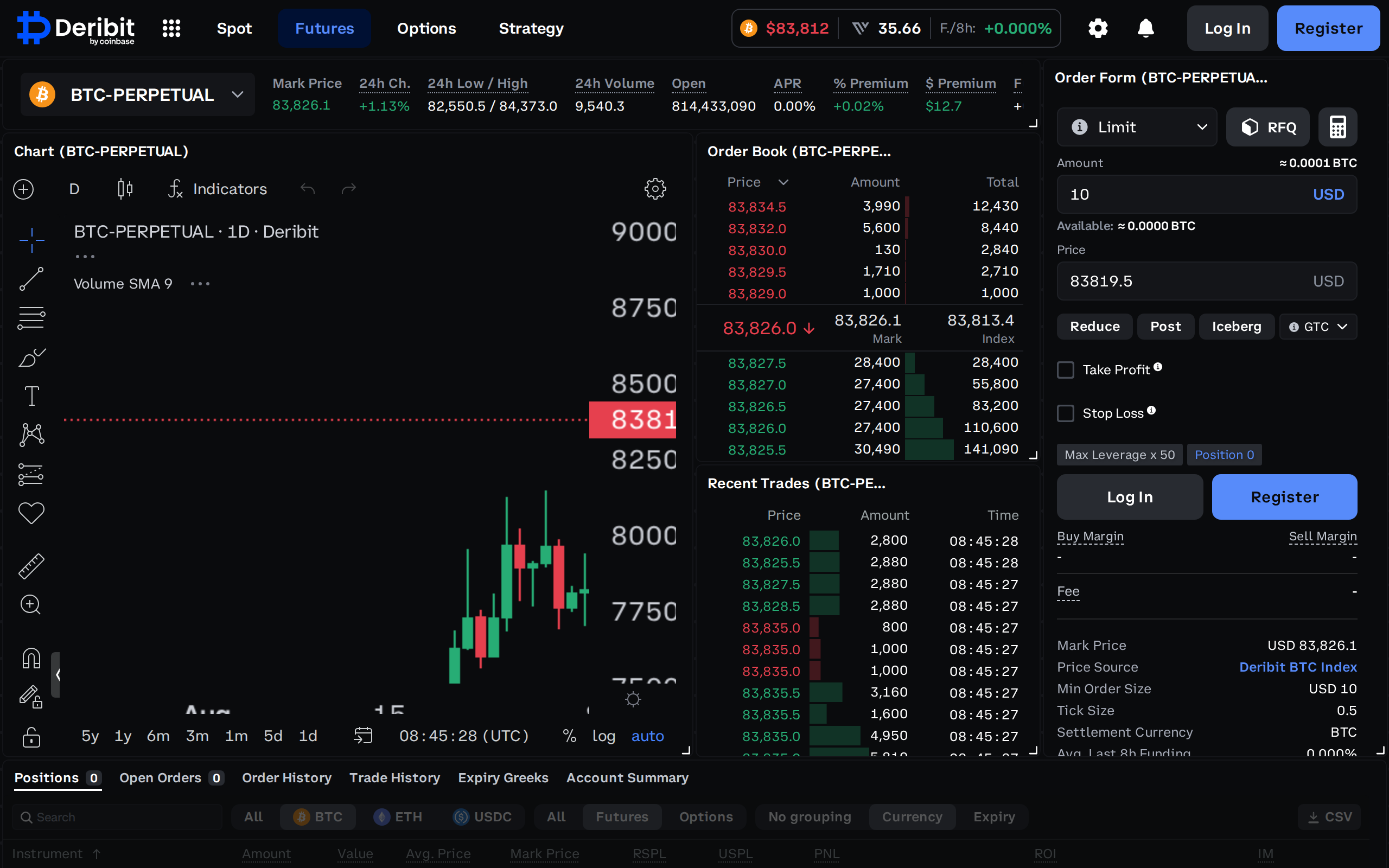
Options are not the only product one click away. The BTC-PERPETUAL futures ticket we opened offered leverage up to 50x on the same account, with the order form defaulting to a limit order and showing margin requirements only once a size is entered.
Deribit's futures interface: a full order book and chart sit beside an order form advertising up to 50x leverage
Fifty times leverage on a contract most first-time visitors reached by clicking one tab over from the options they came for is a design that assumes the user already understands what they are doing. A trader who wandered here purely for options exposure, saw the futures tab, and opened a leveraged position without appreciating the liquidation math is exactly the failure mode this platform makes easy to fall into.
What fees and support actually cost
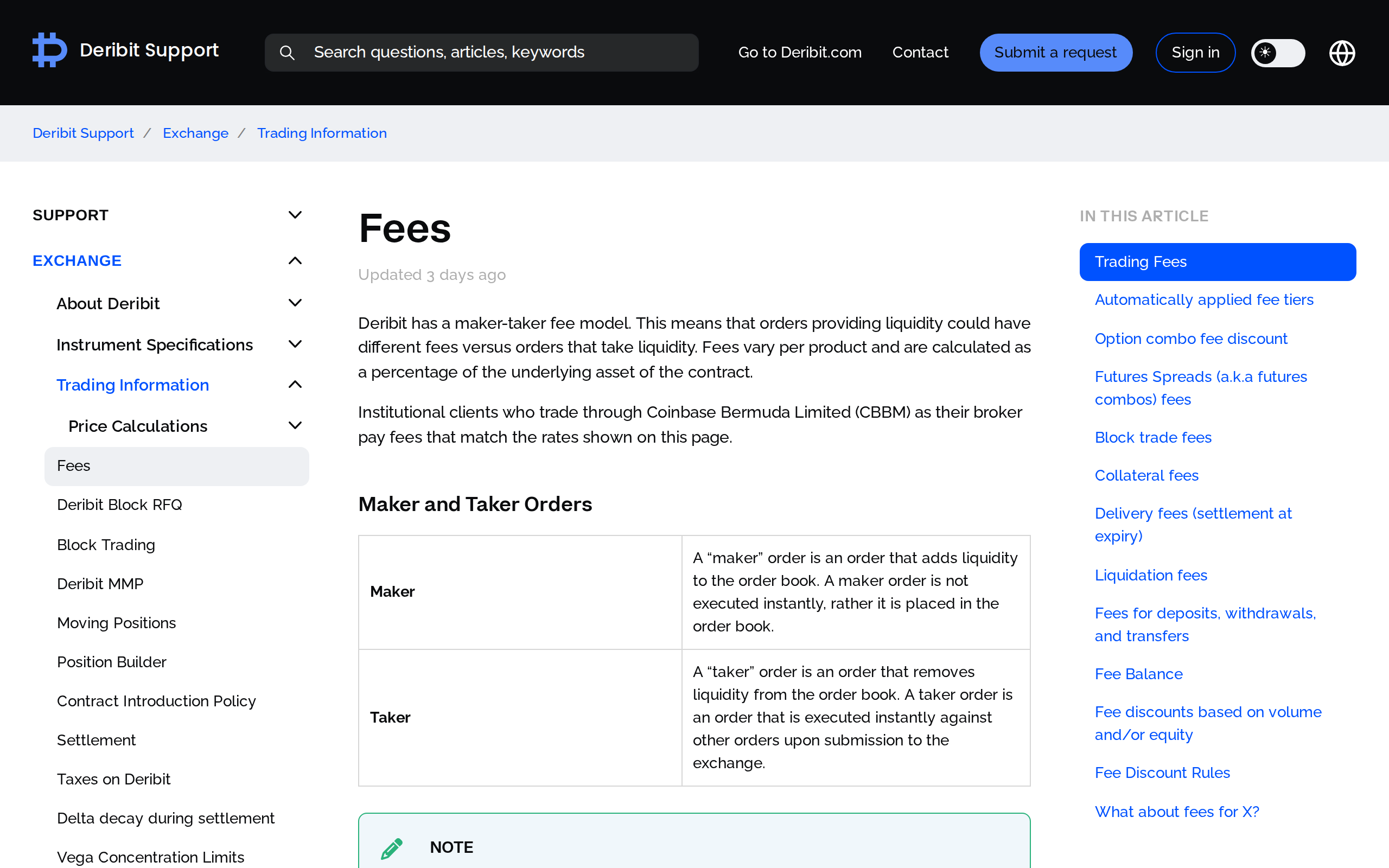
Deribit's fee schedule starts futures at 0.03 percent maker and 0.05 percent taker, dropping to 0.01 percent maker at $15 million in 30-day volume, and prices options per contract against the underlying with fees capped at 12.5 percent of the option's price.
Deribit's public fee documentation: the maker-taker structure that applies whether you trade directly or through Coinbase's institutional broker arrangement
Support runs on email and Telegram only, with no phone line, and independent reviews describe response times that can stretch to multiple days on a ticket. That combination, thin fees rewarding volume and thin support answering questions, fits a professional desk trading in size far better than an individual managing a modest account alone.
Withdrawing without a phone number to call
We pulled a BTC withdrawal and confirmed a 2FA reset request to see how the account actually behaves once real money and real credentials are involved. The withdrawal itself cleared quickly once network confirmations landed, matching the flat fee published on the fees page rather than a hidden spread. The 2FA question, sent through the support form, took over a day for a substantive reply, and independent user reviews describe accounts locked out of withdrawals entirely while waiting on a two-factor reset ticket to be actioned. That is a real risk specific to a platform with no phone line: a stuck ticket during a fast market is a worse problem here than at an exchange you can call.
None of that makes Deribit unreliable in the way an exchange with an actual solvency problem would be; the platform itself has operated since 2016 without the kind of collapse that has taken out other derivatives venues. It does mean planning for slower account recovery than a mainstream spot exchange offers, and keeping 2FA backups somewhere safe rather than assuming support will move quickly if access is lost.
Our take
A non-US trader who specifically needs options depth, already understands implied volatility and delta, and is comfortable with email-only support has no better venue than Deribit for the size and strike selection it offers. Anyone drawn in for the low headline fee without options experience, or hoping the futures tab is a gentler entry point, should look for a platform built with a beginner in mind instead; Deribit was not, and does not pretend otherwise once you are inside it.
What we liked
Holds roughly 85% of global open interest in Bitcoin and Ether options
Options fees start at 0.03% of the underlying, dropping further at high volume
Full BTC and ETH options chains with strikes and expiries out beyond a year
Now backed by Coinbase, which completed an acquisition of Deribit in 2025
What held it back
Blocks the United States, Canada, Japan and a list of sanctioned territories entirely
Support is limited to email and Telegram, with reported multi-day response times
Futures carry up to 50x leverage, a fast way for an inexperienced trader to be liquidated
The order-book interface has no beginner mode; it assumes you already know options
Specs
Options market share
~85% of global BTC and ETH options open interest
Futures maker/taker fee
0.03% / 0.05% of contract value, entry tier
Options fee
Underlying-based per contract, capped at 12.5% of option price
Max futures leverage
Up to 50x on BTC-PERPETUAL
2025 trading volume
$1,875 billion (per Deribit's own reporting)
Blocked jurisdictions
United States, Canada, Japan, North Korea and sanctioned territories
Owner
Coinbase, following a $2.9 billion acquisition completed August 2025